.svg)


15 Project Management Techniques Every Manager Should Use
Project Management Techniques are used to plan, organise, and control tasks, resources, and timelines to complete projects efficiently and achieve goals. Techniques like Agile, Scrum, and Kanban improve teamwork, workflow visibility, and productivity. They also help businesses reduce risks and deliver successful project outcomes.

David Walter
Have you ever worked on a project that started smoothly but slowly became stressful as deadlines approached? Tasks get delayed, priorities keep changing, team communication becomes confusing, and suddenly the entire project feels difficult to manage. These situations are extremely common in workplaces today, especially when teams do not follow structured Project Management Techniques.
This is where the right Project Management Techniques make a real difference. Techniques like Agile, Scrum, Kanban, and Waterfall help teams stay organised, improve collaboration, and manage projects more efficiently. This blog discusses their benefits and importance for successful project delivery. Let’s dive in!
15 Project Management Techniques You Should Know
Different projects require different management approaches based on their goals, timelines, and complexity. Some techniques focus on flexibility and collaboration, while others prioritise planning, scheduling, and cost control for better project execution.
Below are the widely used Project Management Techniques that help businesses improve productivity, manage risks, and deliver projects successfully across different industries:
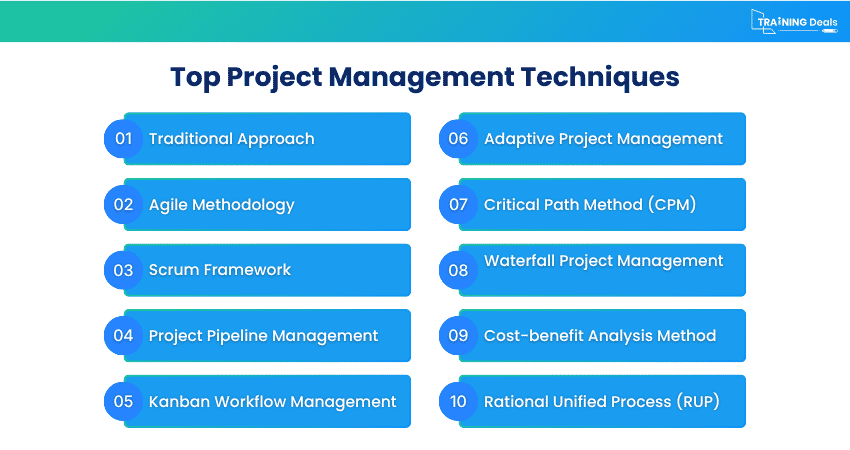
1) Traditional Approach
The Traditional Approach is a structured Project Management Technique that follows a fixed sequence of planning, execution, and delivery stages. It focuses heavily on detailed documentation, predefined timelines, budgets, and clearly defined project objectives from the very beginning.
This approach is most suitable for projects with fixed requirements and minimal changes. Industries such as construction and manufacturing commonly use it because it provides better control, predictable workflows, and easier progress tracking throughout the project lifecycle. Its structured nature ensures stability, making it ideal for projects where accuracy and compliance are critical.

2) Agile Methodology
Agile Methodology is a flexible Project Management Technique that focuses on collaboration, customer feedback, and continuous improvement. Projects are divided into smaller development cycles, allowing teams to adapt quickly to changing business needs and customer expectations.
This method encourages regular communication, faster delivery, and continuous testing throughout the project lifecycle. Agile is widely used in software development and digital projects because it improves flexibility, reduces risks, and helps teams respond quickly to project changes.
3) Scrum Framework
Scrum Framework is an Agile-based Project Management Technique that organises work into short cycles called sprints. Teams collaborate closely to complete tasks, review progress regularly, solve issues quickly, and improve project delivery through continuous feedback and communication.
The framework includes important roles such as Scrum Master, Product Owner, and Development Team members. Scrum improves transparency, accountability, teamwork, and adaptability, making it highly suitable for software development and fast-moving project environments requiring regular updates.
4) Project Pipeline Management
Project Pipeline Management helps organisations manage multiple projects simultaneously while aligning them with business goals and priorities. It focuses on evaluating, selecting, monitoring, and allocating resources across projects to maximise organisational efficiency and performance.
This technique improves visibility into project progress, budgeting, and resource usage across departments. Businesses use Project Pipeline Management to reduce project conflicts, improve strategic decision-making, and ensure teams focus on projects delivering the highest business value.
5) Kanban Workflow Management
Kanban Workflow Management is a visual Project Management Technique that helps teams track tasks using boards and workflow stages. Tasks move through columns such as pending, in progress, testing, and completed to improve workflow visibility, task prioritisation, and team coordination.
This approach helps teams identify bottlenecks, reduce delays, and manage workloads more effectively. Kanban supports continuous delivery and productivity improvement, making it widely useful in software development, operations management, and service-based business environments.
6) Adaptive Project Management
Adaptive Project Management is a flexible technique designed for projects that experience frequent changes or uncertainty. It allows teams to adjust plans, schedules, and strategies continuously based on feedback, risks, evolving market conditions, and changing customer or business requirements.
This method focuses on collaboration, continuous learning, and rapid decision-making throughout project execution. Adaptive Project Management is commonly used in innovation-driven industries where businesses must respond quickly to market changes and evolving project conditions.
7) Critical Path Method (CPM)
Critical Path Method (CPM) is a scheduling technique used to identify the longest sequence of tasks required to complete a project. It helps managers understand which activities directly impact project timelines, resource allocation, task dependencies, and overall project completion deadlines.
By identifying critical tasks, managers can prioritise resources and monitor delays more effectively throughout project execution. CPM improves schedule planning, workflow coordination, and project tracking, especially in construction, engineering, and infrastructure development projects.
Gain recognised Project Management knowledge with the PRINCE2® Foundation Training – Sign up now!
8) Waterfall Project Management
Waterfall Project Management is a sequential technique where each project phase must be completed before the next stage begins. It follows a structured flow that includes planning, design, development, testing, deployment, maintenance activities, and detailed project documentation throughout execution.
This method works best for projects with clearly defined requirements and limited expected changes. Waterfall improves documentation, project tracking, and compliance management, making it suitable for industries requiring strict planning and predictable project delivery processes. Its step-by-step approach ensures clarity and control throughout the project lifecycle.
9) Cost-benefit Analysis Method
Cost-benefit Analysis Method is a financial evaluation technique used to compare expected project costs with anticipated benefits. It helps businesses identify whether a project is financially worthwhile before investing resources, budgets, and operational efforts into execution.
This technique supports better financial planning, risk reduction, and investment decision-making for organisations. Managers use Cost-benefit Analysis to prioritise projects, improve budgeting accuracy, and ensure projects deliver measurable business value and long-term returns. It ensures that resources are invested in projects with the highest potential returns.
10) Rational Unified Process (RUP)
Rational Unified Process (RUP) is a structured software development methodology that combines iterative development with strong planning, documentation, and risk management practices. It divides projects into multiple phases to improve project control and product quality.
RUP focuses heavily on requirement analysis, testing, stakeholder communication, and continuous improvements throughout development. This technique is commonly used in software engineering projects where teams require flexibility while maintaining strong project structure and documentation standards.
11) Extreme Project Management
Extreme Project Management is designed for highly uncertain projects where requirements, goals, or technologies may change frequently. It focuses on flexibility, experimentation, continuous feedback, and rapid decision-making to help teams manage unpredictable project environments effectively.
This technique encourages innovation, collaboration, and quick adaptation during project execution. Businesses commonly use Extreme Project Management in research, technology, and innovation projects where traditional planning methods may struggle to handle constant changes efficiently.
12) Project Network Diagram
A Project Network Diagram is a visual representation showing project activities, task dependencies, and workflow sequences. It helps managers understand how tasks connect, improve project scheduling accuracy, and identify possible conflicts or delays before project execution begins.
This technique improves planning accuracy, communication, and resource coordination throughout the project lifecycle. Project managers commonly use Network Diagrams together with scheduling techniques such as CPM and PERT for better project timeline management and workflow visibility. It enhances clarity by visually mapping task relationships and dependencies.
13) Earned Value Management
Earned Value Management (EVM) is a Project Management Technique used to measure project performance by comparing planned work, completed work, and actual project costs. It helps managers monitor schedule efficiency, track budget performance accurately, and improve overall project cost control.
EVM supports early problem detection, improved forecasting, and better financial control throughout project execution. Organisations commonly use this technique in large projects where maintaining cost control, progress tracking, and accurate reporting are highly important for project success.
14) Project Evaluation and Review Technique (PERT)
Project Evaluation and Review Technique (PERT) is a scheduling method used to estimate project completion time when task durations are uncertain. It uses optimistic, pessimistic, and most likely time estimates to create more realistic project schedules, timelines, and resource planning forecasts.
PERT helps managers analyse uncertainty, reduce scheduling risks, and improve project coordination for complex projects. This technique is widely used in research, engineering, product development, and innovation projects where accurate time estimation is difficult during initial planning stages.
15) Project Feasibility Study
A Project Feasibility Study is an evaluation process used to determine whether a project is practical, achievable, and financially viable before execution begins. It examines technical, operational, legal, financial, and resource-related factors that may affect overall project success.
This study helps businesses reduce risks, improve planning, and avoid investing in unrealistic projects. Organisations conduct feasibility studies to support better decision-making, resource allocation, budgeting, long-term planning, and overall project success before committing to large investments. It ensures informed decision-making before committing resources to a project.
Strengthen your project leadership abilities through the PRINCE2® Practitioner Training – Join today!
The Importance of Effective Project Management Techniques
Effective Project Management Techniques help businesses improve planning, teamwork, productivity, and cost control throughout the project lifecycle. Below are some key reasons why these techniques are important for successful project delivery:
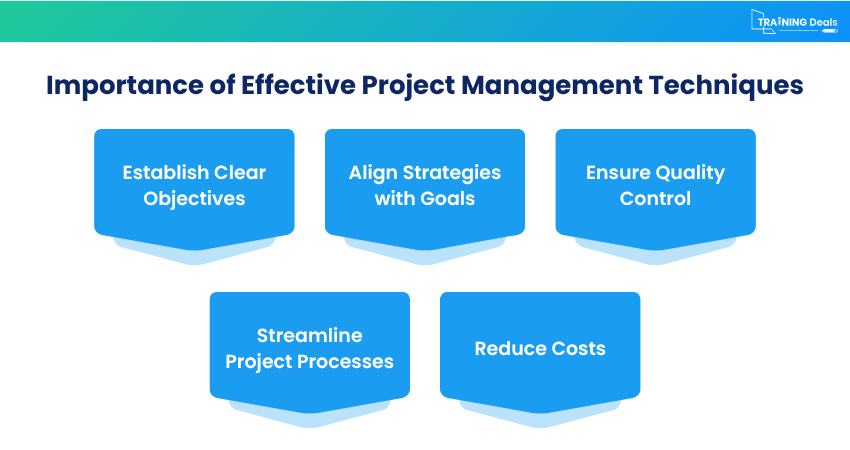
1) Establish Clear Objectives
Project Management Techniques help managers create clear goals, priorities, and deliverables for teams to follow throughout the project. When objectives are properly defined, team members understand their responsibilities, project expectations, deadlines, and desired outcomes more clearly.
Clear objectives also improve focus, communication, and overall project coordination among teams and stakeholders. Understanding project goals from the beginning helps managers identify possible risks early, improve planning accuracy, and take corrective actions before they affect project success.
2) Align Strategies with Goals
Project Management Techniques help organisations align project activities with overall business goals and strategies more effectively. This alignment improves consistency across departments and ensures that teams work together towards common organisational objectives and priorities.
When project strategies support business goals, collaboration and communication between teams become much stronger and more organised. It also helps departments fulfil their responsibilities more efficiently while improving productivity, resource management, and long-term business performance.
3) Ensure Quality Control
Maintaining quality is essential for delivering reliable project outcomes and meeting customer expectations successfully. Project Management Techniques help managers monitor task completion, project performance, and deadlines more effectively throughout the entire project lifecycle.
These techniques often use structured planning, tracking systems, and visual tools to improve project visibility and control. Better monitoring allows managers to identify issues quickly, maintain quality standards, reduce errors, and improve the overall success of project deliverables.
4) Streamline Project Processes
Project Management Techniques help teams work proactively by identifying challenges and delays before they become major problems. Structured workflows improve coordination, communication, and task management, helping organisations complete projects more efficiently and with fewer disruptions.
Improved project processes also increase productivity and ensure deliverables remain aligned with timelines and quality requirements. By organising workflows properly, businesses can reduce confusion, improve collaboration, and maintain smoother project execution from beginning to completion.
5) Reduce Costs
Effective Project Management Techniques help organisations optimise resources, monitor risks, and reduce unnecessary operational expenses during project execution. Proper planning and tracking help managers identify common delays, inefficiencies, and barriers that may increase project costs.
By recognising these issues early, project managers can implement solutions quickly and avoid financial waste or scheduling problems. Better cost control improves profitability, supports efficient resource allocation, strengthens budget management practices, and increases the overall success rate of business projects.
Conclusion
Successful projects rarely happen by chance because they depend on the right planning and management approach. From Agile and Scrum to CPM and Kanban, Project Management Techniques help businesses improve teamwork, reduce risks, manage resources efficiently, and deliver better results. Choosing the right technique can make project execution smoother, faster, and far more successful.
Strengthen your Project Management expertise through the PRINCE2® Training – Register now!
Search
- PRINCE2 vs APM: A Complete Guide to their Differences
- 10+ Project Management Tools to Boost Productivity in 2026
- What is Scrum? Agile Framework Explained
- What is Project Management? Phases, Approaches, and Benefits
- What is Agile Project Management? A Comprehensive Guide
- What are Project Management Skills: Top 25+ Skills You Must Know
- AI in Project Management: Benefits, Challenges, and Best Practices
- What is the Critical Path Method in Project Management? Explained
- What is Project Management Triangle? Key 3 Constraints Explained
- What are the Principles of Management? A Complete Overview
- ITIL Framework: Definition, Benefits and Implementation Explained
- What is Workflow Management? A Comprehensive Guide
- What is a Project Management Plan? Key Components and Benefits
- Why is Project Management Important? Top 12 Reasons & Tips
- Top 15 Project Management Methodologies You Should Know in 2026
- Project Timeline Explained: Simple Steps to Create Effective Plans
- How to Become a Project Manager: Skills, Steps, and Career Path
- Project Charter Explained: Components & How to Write It Effectively
- Program Manager vs Project Manager: A Complete Comparison Guide
- The 5 Project Management Phases Every Professional Should Know
- What is Risk Mitigation: Types, Steps, and Best Practices
No match found
Latest Blog
What is Risk Mitigation: Types, Steps, and Best Practices
June 27, 2026
The 5 Project Management Phases Every Professional Should Know
June 23, 2026
Program Manager vs Project Manager: A Complete Comparison Guide
June 23, 2026
Project Charter Explained: Components & How to Write It Effectively
June 23, 2026
FAQ
The five basics of Project Management include:
1) Initiation
2) Planning
3) Execution
4) Monitoring and Controlling
5) Closure
The 7 Strategies of Project Management include scope, time, cost, quality, resource, communication, and risk management. These strategies help teams stay organised, manage challenges effectively, improve collaboration, control budgets, and deliver successful project outcomes within deadlines.
The triangle of Project Management includes three key constraints:
1) Scope: Defines the project goals, deliverables, and required work
2) Time: Refers to project schedules and deadlines
3) Cost: Covers the project budget and resource expenses
.svg)