.svg)


What is Workflow Management? A Comprehensive Guide
Workflow Management describes the systems and tactics companies use to increase productivity, alleviate frustration, and streamline the flow of tasks. It is the process of organising, managing, and automating tasks so work moves smoothly from start to end. This reduces delays, improves efficiency, and consistency across projects.
Maria Thompson
Have you ever wondered why some projects move effortlessly while others get tangled in delays, confusion, and constant follow-ups? The difference often lies in having a clear and structured process. That is where understanding What is Workflow Management makes a real impact, guiding how tasks, approvals, and information move seamlessly from one stage to the next.
By creating clarity and structure, it improves productivity, reduces errors, and enables teams to automate repetitive tasks while tracking progress in real time. In this blog, you will explore What is Workflow Management, its different types, key elements, benefits, and practical insights to help you build more efficient and organised processes.
What is Workflow Management?
Workflow Management is the structured coordination and optimisation of tasks and processes to ensure work flows through a clear and organised sequence. It involves designing, executing, and continuously improving how activities move from one stage to the next to achieve business objectives efficiently.
By defining each step, assigning clear responsibilities, and aligning people with systems, Workflow Management ensures consistency, accountability, and seamless collaboration across operations. It also enhances visibility into processes, enabling teams to identify bottlenecks early and continuously improve performance.
Why is Workflow Management Important?
Workflow Management is important because it brings clarity and structure to everyday work. Its importance can be understood through the four essential questions as mentioned below:
1) What needs to be done?
2) Who is responsible?
3) When should it be completed?
4) How should it be achieved?
Answering these questions helps teams avoid confusion, reduce delays, and keep tasks moving smoothly. When applied effectively, Workflow Management combines visibility, automation, and support tools to guide people and processes. This ensures the right roles handle the right actions at the right time.
Types of Workflow Management
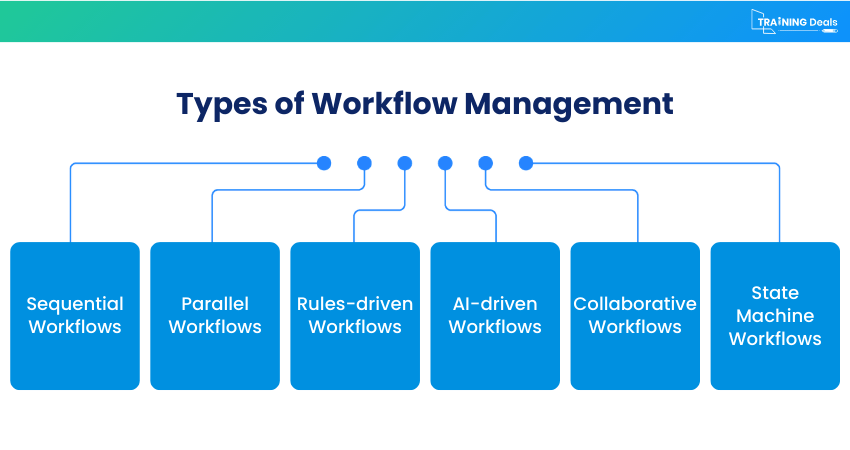
Workflows can be structured in different ways based on the complexity, flexibility, and goals of a process. Let's look at its types below:
1) Sequential Workflows
Sequential Workflows follow a structured and sequential order. Each task must be completed before the next one begins. This is the most common and straightforward type of workflow, ideal for processes that require a clear structure and defined progression, such as approvals or onboarding procedures.
2) Parallel Workflows
Parallel Workflows run multiple tasks simultaneously rather than in a strict sequence. Here, tasks are divided into separate paths and combined before the process continues. This approach reduces processing time and increases efficiency by enabling teams or systems to work simultaneously.
3) Rules-driven Workflows
Rules-driven Workflows follow different paths based on specific conditions, decisions, or approvals. The flow changes depending on predefined rules. Due to its complexity, they often require dedicated Workflow Management software and are commonly used in processes with multiple outcomes.
4) AI-driven Workflows
AI-driven Workflows use Artificial Intelligence (AI) to analyse data, adapt to changes, and make decisions automatically. They help optimise processes, automate repetitive tasks, and improve results with minimal involvement of humans. These workflows support intelligent automation and foster continuous improvement.
5) Collaborative Workflows
Collaborative Workflows combine elements of sequential, parallel, and automated processes within a single workflow. Here, a process may start in a linear order, branch into parallel tasks, and eventually, merge back together. This type offers both flexibility and control while maintaining oversight.
6) State Machine Workflows
State Machine Workflows allow tasks to move through defined stages, but the order can vary depending on the situation. Here, the sequence is flexible within each stage, making this type suitable for dynamic environments where requirements keep changing frequently.
Validate your Agile leadership and enhance your credibility with the Certified Professional in Agile Project Management (CPAPM) Course now!
Key Elements of Effective Workflow Management
An effective workflow is built on a clear structure and defined components. Understanding these key elements ensures processes run smoothly, deliver value, and achieve desired business outcomes. Let’s look at them below:
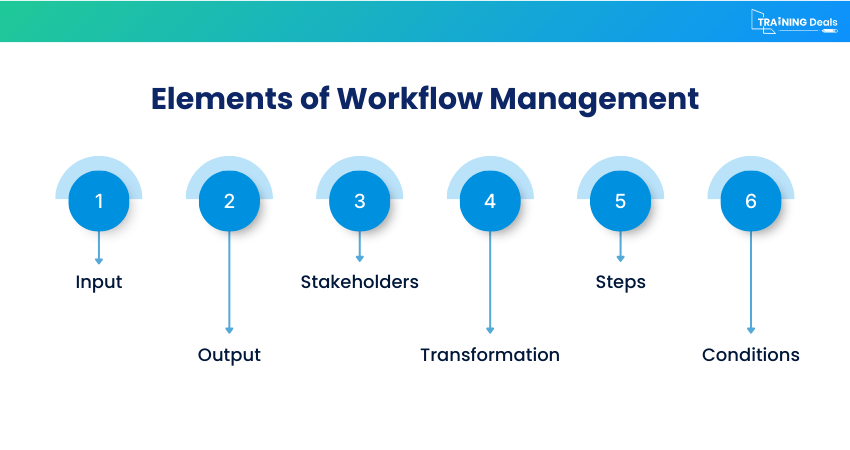
1) Input
Input refers to the resources, materials, or information needed to begin and sustain a workflow. It includes data, documents, instructions, or tools needed to complete tasks effectively. Without accurate and timely inputs, the workflow cannot function properly.
2) Output
Outputs are the results produced by the workflow. They may be a completed product, delivered service, report, or achieved objective. Outputs help to determine whether the workflow has met its desired goals and delivered the expected business value.
3) Stakeholders
Stakeholders are the individuals or groups involved in or affected by the workflow. They may perform tasks, make decisions, or review progress. Clearly identifying stakeholders ensures accountability, improves communication, and supports seamless collaboration throughout the process.
4) Transformation
Transformations describe how inputs are converted into outputs. As tasks are completed, resources and information are processed and refined to create value at each stage. This highlights how work evolves throughout the workflow.
5) Steps
Steps are the specific tasks or actions that move the workflow forward. Each step contributes to progress and ensures the process follows a structured path from beginning to end. Clearly well-defined steps reduce confusion, prevent delays, and maintain consistency.
6) Conditions
Conditions are the requirements that must be met before the workflow begins or concludes. It includes approvals, resources, compliance standards, or external factors. Meeting the right conditions ensures the workflow operates effectively and delivers reliable results.
Advance your Agile skills for real-world project success with the Agile Project Management Practitioner (AgilePM® v3) Course now!
What are the Benefits of Workflow Management?
When workflows are clearly defined and continuously improved, they deliver multiple benefits across teams and organisations. Let’s look at its benefits below:
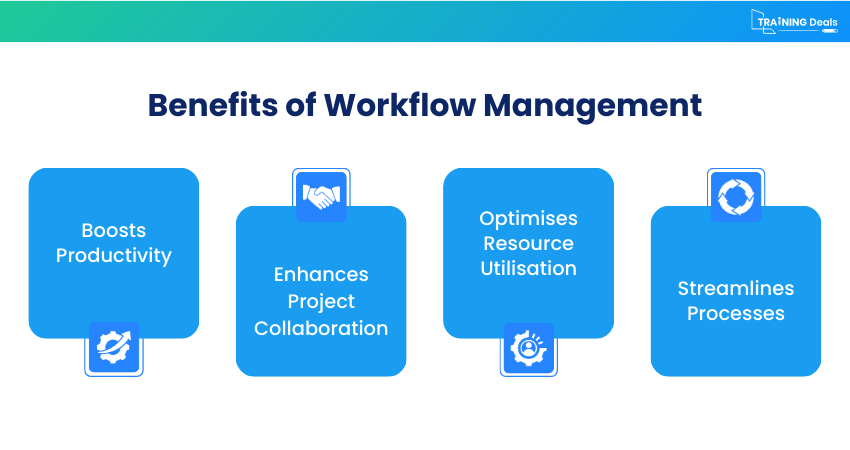
1) Boosts Productivity
Workflow Management reduces confusion by clearly outlining tasks, responsibilities, and deadlines. When teams know exactly what to do and when to do it, they can focus on core activities without wasting time. This clarity significantly increases overall productivity.
2) Enhances Project Collaboration
Effective workflows break down silos and promote transparency. This enables team members to easily see task assignments, deadlines, and dependencies. It ensures smoother coordination, improved communication, and strengthens collaboration across departments.
3) Optimises Resource Utilisation
Workflows are useful for identifying the resources needed at each stage of a process. Allocating resources properly helps organisations to avoid bottlenecks and ensure that people, tools, and systems are used to their full potential.
4) Streamlines Processes
Mapping workflows highlights inefficiencies, repetitive actions, and unnecessary steps. It is crucial to address these issues since it is useful for organisations to simplify processes, reduce delays, and improve operational efficiency.
Overcoming Workflow Management Challenges
While Workflow Management brings various benefits, it also comes with its own set of challenges. Understanding and addressing these challenges ensures a comprehensive understanding of What is Workflow Management. Let’s look at them below:
1) Resistance to Change
Employees may prefer familiar ways of working and be resistant to adopting new processes. To overcome this, clearly communicate the benefits of the workflow, focusing on improved efficiency and reduced frustration. Also, encourage feedback and involve stakeholders in designing workflows to build trust and attract stronger buy-in.
2) Unclear Processes
If workflows are poorly defined, it can create confusion and slow down progress. To overcome this, document each workflow clearly, outlining tasks, responsibilities, required resources, and expected outcomes. Clear documentation ensures everyone understands their role and what is expected at every stage of the process.
3) Communication Barriers
Due to information silos and weak communication, workflow continuity can be disrupted. It is important to foster a culture of open communication by encouraging team members to share updates, raise questions, and collaborate regularly. Transparent communication keeps workflows aligned and prevents misunderstandings from escalating.
4) Technology Limitations
Using unsuitable tools can complicate the entire process. It is crucial to carefully select the right Workflow Management tools that support automation, visibility, and collaboration. The right technology should streamline operations and improve productivity.
Build strong Agile foundations for confident project delivery with Agile Project Management Foundation (AgilePM® v3) Course - Sign up now!
Workflow Management Best Practices
An effective Workflow Management requires continuous monitoring, improvement, and team involvement. Let's look at the best practices below to ensure workflows remain efficient and adaptable:
1) Embrace Documentation
Clearly document every step of the workflow, including required resources and assigned responsibilities. Use flowcharts, diagrams, or visual aids to make processes easier to understand. Proper documentation reduces confusion and ensures consistency across teams.
2) Open Communication
Promote a culture of open and transparent communication. Encourage team members to share updates, ask questions, and collaborate regularly. Use collaboration tools that act as a central hub for workflow details, progress tracking, and discussions.
3) Empower Teams
Give team members ownership of their tasks within the workflow. Provide the training, tools, and resources they need to perform effectively. Also, encourage feedback and suggestions so employees feel valued, heard, and involved in improving the process.
4) Embrace Continuous Improvement
Schedule regular reviews to assess the performance of the workflow. It is crucial to identify bottlenecks, redundancies, or delays and make necessary adjustments accordingly. Being flexible and open to change ensures workflows remain relevant as business needs evolve.
5) Leverage Technology
Adopt Workflow Management software that automates repetitive tasks, supports collaboration, and offers data insights. The right technology enhances visibility, simplifies operations, and drives smarter business decision-making.
Workflow Management vs Project Management
Workflow Management and Project Management are related, but they serve different goals. Let's look at their differences in the table below:
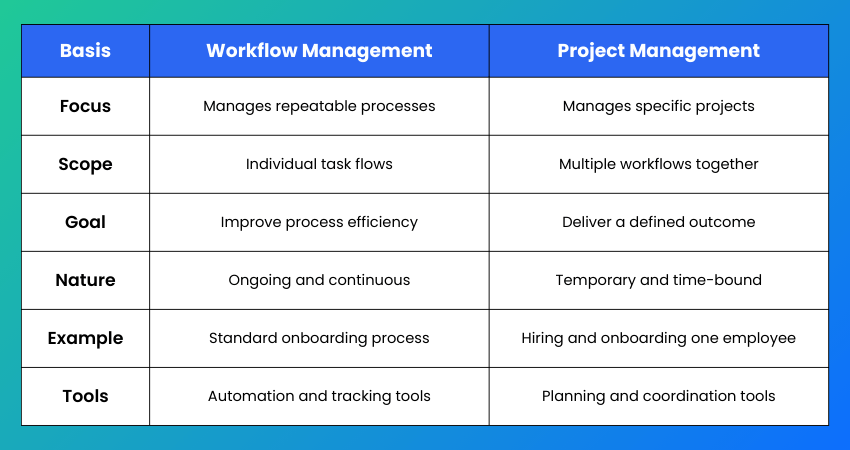
Workflow Management focuses on improving how tasks move through a structured process. It ensures clarity, automation, and consistency in routine operations. For example, it defines and optimises the steps required to onboard employees as a standard procedure.
In contrast, Project Management governs the broader initiative that brings multiple workflows together to achieve a specific objective. It involves planning, coordinating resources, managing timelines, and ensuring successful delivery.
Conclusion
Understanding What is Workflow Management helps create a smoother and more efficient processes that drive real business results. When tasks are clearly defined and the right tools are employed, teams can reduce delays, improve collaboration, and focus on meaningful work. Continuously refining workflows and embracing smart automation builds systems that consistently deliver better outcomes.
Accelerate your Project Management career with Agile Training today!
Search
- PRINCE2 vs APM: A Complete Guide to their Differences
- 10+ Project Management Tools to Boost Productivity in 2026
- What is Scrum? Agile Framework Explained
- What is Project Management? Phases, Approaches, and Benefits
- What is Agile Project Management? A Comprehensive Guide
- What are Project Management Skills: Top 25+ Skills You Must Know
- AI in Project Management: Benefits, Challenges, and Best Practices
- What is the Critical Path Method in Project Management? Explained
- What is Project Management Triangle? Key 3 Constraints Explained
- What are the Principles of Management? A Complete Overview
- ITIL Framework: Definition, Benefits and Implementation Explained
- What is a Project Management Plan? Key Components and Benefits
- Why is Project Management Important? Top 12 Reasons & Tips
- Top 15 Project Management Methodologies You Should Know in 2026
- 15 Project Management Techniques Every Manager Should Use
- Project Timeline Explained: Simple Steps to Create Effective Plans
- How to Become a Project Manager: Skills, Steps, and Career Path
- Project Charter Explained: Components & How to Write It Effectively
- Program Manager vs Project Manager: A Complete Comparison Guide
- The 5 Project Management Phases Every Professional Should Know
- What is Risk Mitigation: Types, Steps, and Best Practices
No match found
Latest Blog
What is Risk Mitigation: Types, Steps, and Best Practices
June 27, 2026
The 5 Project Management Phases Every Professional Should Know
June 23, 2026
Program Manager vs Project Manager: A Complete Comparison Guide
June 23, 2026
Project Charter Explained: Components & How to Write It Effectively
June 23, 2026
FAQ
No FAQs available for this blog.
.svg)