.svg)


Top 15 Project Management Methodologies You Should Know in 2026
Project Management Methodologies include Waterfall, Agile, Scrum, and PRINCE2, each offering structured approaches to planning, executing and managing projects. They provide frameworks, processes, and best practices that help teams organise tasks, manage resources, and deliver projects efficiently while supporting organisational goals.
David Walter
The blend of innovation, agility and cutting-edge strategy is pushing modern Project Management into a dynamic new landscape. So, whether you're leading global teams or steering a startup's next big leap, choosing the right Project Management Methodologies can make all the difference between success and failure.
From traditional methods like Waterfall to modern Agile frameworks, each methodology offers unique strengths. In this blog, we'll explore the 15 best Project Management Methodologies, from cutting‑edge hybrid models to time‑tested classics. So read on and make the right choice to manage projects smarter and achieve better results!
What is a Project Management Methodology?
A Project Management Methodology is a structured approach that includes principles, tools, and techniques for planning, executing and controlling projects. It provides a framework that helps Project Managers organise tasks, guide team members, and manage project activities effectively while encouraging clear communication and collaboration across the team.
By following a defined methodology, organisations can maintain consistency in how projects are delivered. It also helps teams manage risks, allocate resources efficiently and track progress against objectives. This increases the likelihood of completing projects on time and within budget.
Why is Project Management Methodology Important?
A Project Management Methodology is important because it provides a structured and consistent approach to planning, executing, and controlling projects. It helps teams manage tasks efficiently, mitigate risks, and deliver outcomes within the defined timeline and budget.
The following are the key reasons it is important:
1) Provides Structure and Clarity:
A defined methodology outlines the steps, processes, and responsibilities involved in a project. This structure helps teams understand what needs to be done and how to approach each stage of the project.
2) Improves Communication and Collaboration:
Standardised processes make it easier for team members and stakeholders to share information, track progress, and coordinate tasks effectively.
3) Enhances Risk Management:
Project Management Methodologies include planning and monitoring practices that help identify potential risks early and address them before they affect project outcomes.
4) Supports Better Resource Allocation:
Using a methodology helps Project Managers assign tasks, manage budgets, and use resources more efficiently throughout the project lifecycle.
5) Increases Project Success Rates:
Clear processes, defined roles, and consistent monitoring improve the chances of completing projects on time, within budget, and according to stakeholder expectations.
6) Ensures Consistency Across Projects:
When organisations follow a standard methodology, teams can deliver projects in a consistent and predictable manner, even when multiple projects are running simultaneously.
What are the Different Types of Project Management Methodologies?
Now, let’s explore the different Project Management Methodologies applicable to a diverse range of team structures and project complexities:
1) Waterfall Methodology
This is a traditional Project Management approach where tasks and phases are completed in a linear and sequential order. Each stage must be finished before the next one begins, creating a structured flow of work throughout the project lifecycle.
The typical stages in a Waterfall project include:
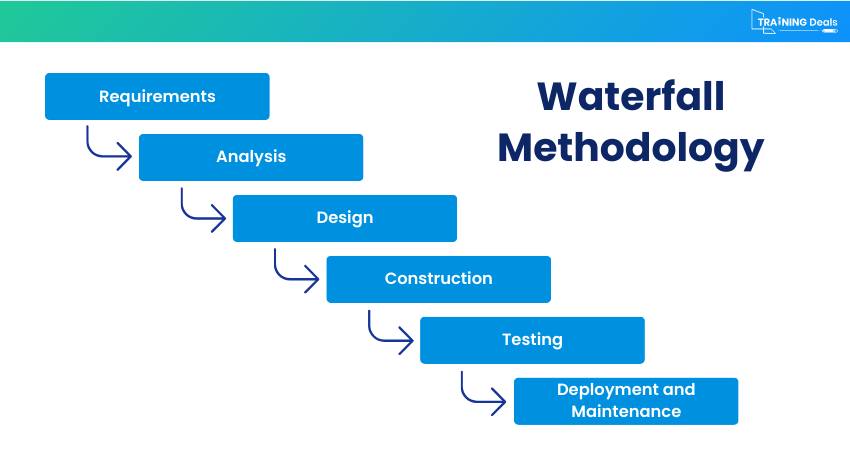
a) Requirements
b) Analysis
c) Design
d) Construction
e) Testing
f) Deployment and maintenance
In this model, progress moves in a single direction, similar to the downward flow of a waterfall. However, once a phase is completed, it is usually difficult to return and make modifications. This methodology works well when:
a) The project goals and final deliverables are clearly defined from the beginning
b) Stakeholders have a clear understanding of their requirements
c) The project environment is stable and predictable
d) The industry requires strong documentation, compliance, or regulatory tracking
e) New team members may need to join the project and quickly understand the process
2) Agile Methodology
This is one of the most common Project Management Methodologies and was created as a response to the drawbacks of traditional linear Project Management approaches. Many teams found that conventional methods didn't have the flexibility needed to adapt as projects evolved. As a result, organisations began adopting iterative models that allow teams to review, refine and adjust their work throughout the project.
Agile methodologies typically involve short work cycles where teams regularly test progress, evaluate results, and make adjustments when necessary. In many Agile practices, tasks are organised in a backlog that lists all the work required. Project Managers or Product Owners prioritise this backlog so teams know which tasks to address first during each cycle.
This methodology is most suitable when:
a) Project requirements are likely to change over time
b) The final solution is not fully defined at the beginning
c) Fast progress and regular delivery of results are important
d) Stakeholders or clients need to be actively involved throughout the project lifecycle
Upgrade your project game with our range of PRINCE2® Courses - Register now!
3) Scrum Methodology
Scrum is a framework within Agile Project Management rather than a standalone methodology. It gives a structured way for teams to manage work while maintaining the flexibility and iterative nature of Agile practices. In Scrum, work is divided into short development cycles called sprints, which typically last one to two weeks.
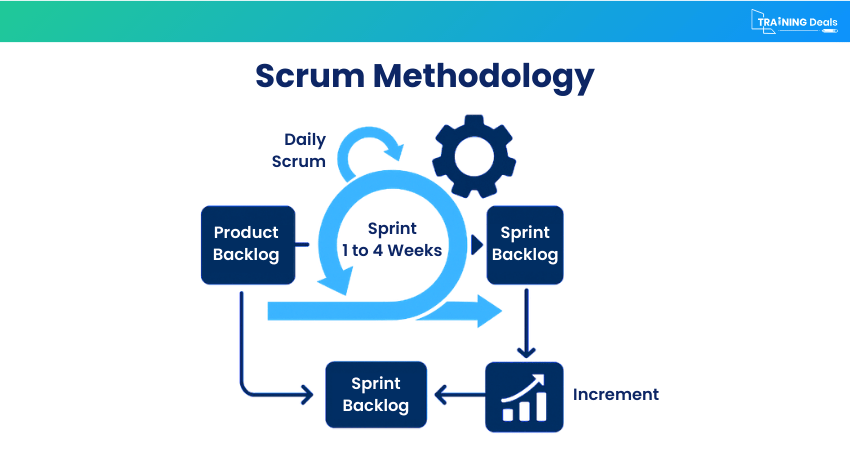
During each sprint, teams complete a set of tasks selected from a prioritised backlog. The process is guided by a Scrum Master, who supports the team, removes obstacles and ensures the Scrum framework is followed. At the end of each sprint, the team assesses its performance through a sprint retrospective, where members discuss what worked well and identify areas for improvement before beginning the next sprint cycle.
This methodology works well when:
a) The team is focused on regular feedback and continuous improvement
b) Collaboration and iterative development are key priorities
This methodology may not be suitable when the team cannot fully commit to the processes and collaboration required for Scrum to succeed.
4) Kanban Methodology
Kanban is another approach used within Agile Project Management that focuses on visualising and managing workflow. Originally created for the manufacturing sector, Kanban has evolved into a framework in which tasks are displayed on a Kanban board and move through columns representing workflow stages.
In this system, tasks are pulled from a backlog whenever the team has the capacity to work on them. As tasks progress, they move across the board from one stage to another, providing a clear visual representation of the project’s status.
Kanban offers teams an immediate overview of ongoing work and makes it easier to track progress in real time. A common practice in Kanban is the use of work-in-progress (WIP) limits, which restrict the number of tasks that can be handled simultaneously. This methodology works well when:
a) A clear visual representation of project progress is needed
b) Teams require quick status updates on tasks and workflows
c) Work-in-progress limits help maintain focus and efficiency
d) Teams prefer a continuous pull-based workflow rather than fixed iterations
5) Scrumban Methodology
Scrumban is a hybrid Agile Project Management approach that combines the elements of Scrum and Kanban. It brings together Scrum’s structured sprint planning with Kanban’s continuous Workflow Management to create a more flexible working model.
One of the key advantages of Scrumban is that teams are not required to select all tasks for a sprint at the beginning. Instead, tasks can be pulled from the backlog whenever the team has the capacity to work on them, similar to the Kanban approach. This allows for a smoother and more continuous workflow.
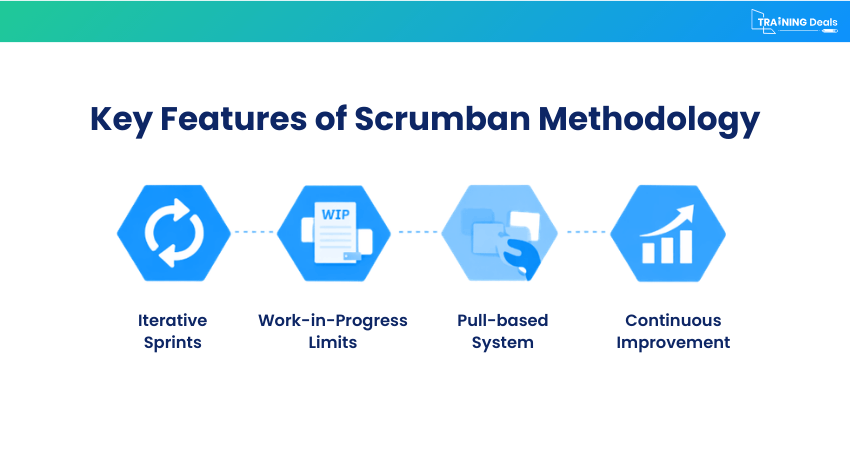
By applying Work-In-Progress (WIP) limits from Kanban within Scrum-style planning cycles, Scrumban enables teams to maintain steady progress while still benefiting from structured activities such as planning sessions, reviews, and retrospectives.
This methodology works well when:
a) Teams want the structured planning of Scrum combined with the flexibility of Kanban
b) Continuous workflow and improved Task Management are important
This methodology may not be suitable when teams prefer to follow either Scrum or Kanban strictly rather than using a hybrid approach.
6) Rapid Application Development (RAD)
Rapid Application Development is a Project Management and Software Development methodology that focuses on fast development and quick delivery of functional components. Instead of long planning cycles, RAD encourages rapid prototyping, user feedback, and iterative improvements throughout the development process.
Teams work in short development phases where prototypes are created and tested with users. This allows projects to evolve quickly while ensuring that the final product meets user expectations.
This methodology works well when:
a) Project timelines are short and rapid delivery is required
b) Users can actively participate in testing and feedback
c) Requirements may evolve during development
d) The project prioritises speed and adaptability over extensive documentation
Our PRINCE2® Practitioner Course will turn you into the strategist that modern projects need - Sign up now!
7) Critical Path Method (CPM)
Critical Path Method is a widely used project scheduling technique used to plan and manage project timelines. In this approach, a project model is created that includes all activities listed in the work breakdown structure, along with their duration, task dependencies, and key milestones that mark major phases or deliverable deadlines.
By analysing this information, Project Managers can identify the longest sequence of dependent tasks needed to complete the project, known as the critical path. These tasks must be carefully monitored because any delay in them can directly impact the overall project timeline.
CPM was created in the 1950s by Morgan R. Walker and James E. Kelley Jr. Earlier versions of the concept were already being used in large-scale projects, including the Manhattan Project. Consider these points:
a) CPM is suitable for projects where task sequencing and scheduling are critical
b) It helps identify dependencies and manage project timelines
c) It works well for small to medium-sized projects
d) It's useful when Project Managers need to monitor tasks that directly affect project completion time
8) Critical Chain Project Management (CCPM)
CCPM is a Project Management approach that focuses primarily on the efficient use of resources required to complete a project, such as team members, equipment, and workspace. Unlike methods that concentrate heavily on task sequencing and scheduling, CCPM emphasises balancing resource availability and maintaining flexibility throughout the project lifecycle.
The concept was introduced in 1997 by Eliyahu M. Goldratt in his book Critical Chain. The methodology is known for improving project performance and has been associated with reducing project duration and costs by improving how resources are managed. Here's when to use it:
a) It’s suitable for projects where resource availability significantly impacts timelines
b) It’s useful for organisations aiming to improve efficiency and reduce project delays
c) It’s applicable to both small and large organisations
d) It's commonly used in industries such as construction, Software Development and technology research and development
9) Lean
Lean is a value-focused Project Management approach that originated in the manufacturing sector and has since been widely adopted in IT and service industries. Its primary objective is to maximise customer value while minimising waste within processes.
Lean teams emphasise continuous process improvement, efficient use of resources, and long-term organisational change. By identifying inefficiencies and simplifying workflows, organisations can improve productivity and deliver better outcomes with fewer resources.
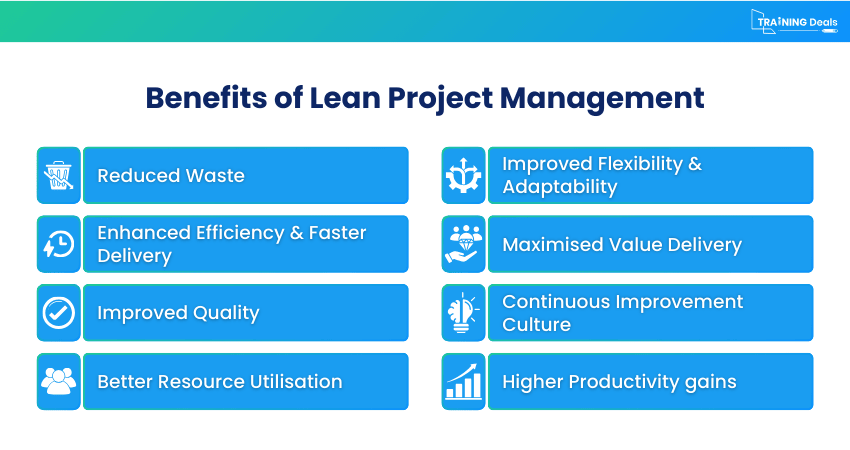
Lean is not ideal for projects that require extensive documentation or strict compliance procedures, or for short-term projects where process redesign may not deliver significant benefits. It is ideal for:
a) Projects focused on improving efficiency and eliminating waste
b) IT services or operational environments with repetitive processes
c) Organisations committed to continuous improvement and optimisation
Build your Project Management basics with the world’s most trusted framework. Sign up for our PRINCE2® Foundation Training now!
10) PRINCE2®
Projects IN Controlled Environments (PRINCE2®) focuses on clearly defined roles, organised project stages, and detailed documentation. It places strong emphasis on governance, control and effective Risk Management throughout the entire project lifecycle.
PRINCE2® is widely used in government, defence, and large enterprise environments where accountability, transparency, and compliance are essential. Its formal and process-driven approach makes it particularly suitable for managing complex and high-risk projects. It's ideal for:
a) Large and complex projects involving multiple stakeholders
b) Projects within government or highly regulated industries
c) Organisations that require strong governance and structured management processes
11) Six Sigma
Six Sigma is primarily a Quality Management approach rather than one of the Project Management Methodologies. It focuses on improving processes and reducing defects to elevate efficiency. Six Sigma is often combined with other frameworks, such as Lean or Agile, resulting in approaches like Lean Six Sigma or Agile Six Sigma.
The main objective of Six Sigma is continuous process improvement by identifying inefficiencies and implementing data-driven solutions. Experts analyse workflows, define improvement strategies and maintain control over processes to ensure long-term performance improvements. A commonly used model within Six Sigma is the DMAIC process, which provides a structured method for improvement through the following stages:
a) Define: Establish the project scope, business objectives, and initial planning discussions
b) Measure: Gather data to understand current performance and identify areas for improvement
c) Analyse: Determine the root causes of problems or inefficiencies
d) Improve: Create and implement solutions to address the identified issues
e) Control: Maintain and monitor the improvements to ensure long-term success
It's primarily used by:
a) Large organisations seeking to improve operational efficiency
b) Businesses aiming to reduce defects and process waste
c) Companies with complex processes where quality improvement can significantly impact performance
12) Extreme Programming (XP)
Extreme Programming is a popular Agile Software Development methodology focusing on technical excellence and rapid delivery of high-quality software. It encourages practices such as pair programming, test-driven development, continuous integration and frequent software releases to improve development efficiency.
XP helps teams minimise defects, enhance code quality, and respond quickly to changing project requirements. It is particularly effective in IT and Software Development environments where adaptability and product quality are critical. It's ideal for the following scenarios:
a) Software Development projects with frequently changing requirements
b) Teams focused on producing high-quality, reliable code
c) Projects that benefit from continuous customer feedback and collaboration
13) Integrated Project Delivery (IPD)
Integrated Project Delivery is one of the more prominent collaborative Project Management Methodologies that brings together key stakeholders such as project owners, contractors, architects, and consultants. These participants work as a unified team, aligning their objectives and sharing project risks to encourage transparency and cooperation.
By promoting open communication and collective decision-making, IPD helps reduce conflicts and improve coordination throughout the project. This collaborative environment can lead to better project outcomes, improved efficiency, higher quality results, and in some cases, reduced project costs. Here’s when to use it:
a) IPD is suitable for complex or long-term projects involving multiple stakeholders
b) It’s effective when project risks need to be shared among participants
c) It’s useful for projects where strong collaboration can minimise conflicts and improve overall efficiency
14) Adaptive Project Framework (APF)
The Adaptive Project Framework is designed to support flexibility and continuous adaptation throughout a project. As the project progresses, APF helps teams make frequent adjustments to the scope, requirements and plans based on evolving circumstances. It also enables organisations to respond effectively to changing client expectations or market conditions.
This framework encourages Project Managers to regularly evaluate processes and deliverables to ensure they stay aligned with stakeholder expectations. When feedback leads to changes, APF enables teams to adjust their strategies while continuing to deliver meaningful value. consider these points:
a) APF is suitable for projects with high uncertainty or evolving requirements
b) It's effective when frequent changes or adjustments are expected
c) It's helpful for teams that need to respond quickly to stakeholder feedback
d) It's ideal for projects where flexibility and resilience are essential to avoid major risks
Manage project complexities with the power of PRINCE2® and the freedom of Agile in our PRINCE2 Agile® Practitioner Course - Sign up now!
15) Precedence Diagramming Method (PDM)
The Precedence Diagramming Method is a project scheduling technique for visually representing the sequence of project activities. In this method, each task is represented as a node or box in a diagram, with arrows illustrating the relationships and dependencies between tasks.
This is one of those Project Management Methodologies that provides a clear visual overview of the order in which tasks must be performed. It helps Project Managers understand which activities must be completed before the others can begin and which tasks can be carried out at the same time. Remember these points:
a) PDM is suitable for projects that require detailed and well-structured scheduling
b) It’s helpful when task dependencies must be clearly defined
c) It’s effective for projects where accurate timing and sequencing are critical
d) It’s useful for improving project planning, monitoring, and execution through visual scheduling
How to Choose the Correct Methodology for Your Project?
Selecting the proper Project Management Methodologies is not about following popular trends. Instead, it involves selecting an approach that best suits the needs of the project. The right methodology depends on factors such as the project’s size, complexity and working environment. Here are some considerations that can help guide this decision:
1) Scope Stability: If project requirements are likely to change frequently, flexible approaches such as Agile or Scrum work best. For projects that have clearly defined requirements, structured methods like Waterfall or PRINCE2® offer greater predictability.
2) Compliance Requirements: Projects in highly regulated sectors such as finance, healthcare or construction often benefit from methodologies like PRINCE2®, Six Sigma or PMBOK. These are where strong governance, documentation and control processes are essential.
3) Team Experience: Highly experienced and cross-functional teams often perform well with Agile or Kanban frameworks that encourage autonomy and collaboration. Teams with less experience may benefit from the clearer structure offered by Waterfall or PRINCE2®.
4) Stakeholder Involvement: Projects that require frequent customer or stakeholder feedback are well-suited to Agile and Scrum. When stakeholder access is limited, traditional approaches with more upfront planning may be more effective.
5) Tools and Support: Agile and Kanban typically rely on visual boards, sprint tracking tools, and continuous progress monitoring. In contrast, methodologies such as Waterfall or PRINCE2® depend more on documentation, stage reviews, and formal approvals.
Conclusion
Making the right pick among the many exciting Project Management Methodologies can transform how teams plan, collaborate and deliver results. As projects grow more dynamic every year, understanding these different approaches can help you adapt to changing needs and industry demands with ease. By selecting the method that best fits your project’s complexity and team structure, you can drive long-term project success.
Master the art of Agile with Scrum at its core and turn teamwork into turbo‑speed project delivery. Sign up for our Managing Agile Projects with Scrum Course now!
Search
- PRINCE2 vs APM: A Complete Guide to their Differences
- 10+ Project Management Tools to Boost Productivity in 2026
- What is Scrum? Agile Framework Explained
- What is Project Management? Phases, Approaches, and Benefits
- What is Agile Project Management? A Comprehensive Guide
- What are Project Management Skills: Top 25+ Skills You Must Know
- AI in Project Management: Benefits, Challenges, and Best Practices
- What is the Critical Path Method in Project Management? Explained
- What is Project Management Triangle? Key 3 Constraints Explained
- What are the Principles of Management? A Complete Overview
- ITIL Framework: Definition, Benefits and Implementation Explained
- What is Workflow Management? A Comprehensive Guide
- What is a Project Management Plan? Key Components and Benefits
- Why is Project Management Important? Top 12 Reasons & Tips
- 15 Project Management Techniques Every Manager Should Use
- Project Timeline Explained: Simple Steps to Create Effective Plans
- How to Become a Project Manager: Skills, Steps, and Career Path
- Project Charter Explained: Components & How to Write It Effectively
- Program Manager vs Project Manager: A Complete Comparison Guide
- The 5 Project Management Phases Every Professional Should Know
- What is Risk Mitigation: Types, Steps, and Best Practices
No match found
Latest Blog
What is Risk Mitigation: Types, Steps, and Best Practices
June 27, 2026
The 5 Project Management Phases Every Professional Should Know
June 23, 2026
Program Manager vs Project Manager: A Complete Comparison Guide
June 23, 2026
Project Charter Explained: Components & How to Write It Effectively
June 23, 2026
FAQ
No FAQs available for this blog.
.svg)