.svg)


What are the Principles of Management? A Complete Overview
The Principles of Management are guidelines that help Managers plan, organise, lead, and control resources to improve efficiency and reduce conflicts. Introduced by Henri Fayol, the 14 principles promote authority, teamwork, fair treatment, and proper communication. They support better decision-making and coordination across departments.


Hailey Davis
Managing people is often harder than managing money or technology. An organisation may have skilled employees and advanced systems, yet work can still face confusion when responsibilities are unclear, and communication is weak. The real problem is not effort or skill but the lack of clear guidance on how work should be organised. This is exactly why the Principles of Management were developed.
They offer a framework that helps plan work strategically, assign duties, and guide teams in the right direction. In this blog, you will learn what are the Principles of Management, and how they function in real workplace situations with simple examples. Let's get started!
What are the Principles of Management?
The Principles of Management are fundamental guidelines that help managers operate an organisation effectively. They explain how managers can plan work, organise resources, lead employees, and monitor performance so that organisational goals can be achieved smoothly. They guide managers to:
1) Plan: Set goals and decide in advance what work needs to be done and how to achieve it.
2) Organise: Arrange resources, tasks, and responsibilities so work is carried out smoothly.
3) Lead: Guide, motivate, and support employees to perform their duties effectively.
4) Control: Track performance and compare results with plans to ensure objectives are met.
These Principles of Management were introduced by Henri Fayol, who observed that every organisation needs clear authority and defined responsibilities to function well. They are not strict rules but practical ideas that can be applied according to different situations, the size of the team, and the type of business.

Who was Henri Fayol?
Henri Fayol was a French Mining Engineer and Management Theorist. During his career, he worked in a large mining company and eventually became its Managing Director. While handling administrative responsibilities, he observed how managers coordinated people and organisational activities and identified patterns that successful managers followed.
This led him to study management in particular. With that, Fayol introduced two major contributions:
1) The five functions of management such as planning, organising, commanding, coordinating, and controlling.
2) The 14 Principles of Management, which became the foundation of modern management practices.
Henry Fayol's 14 Principles of Management With Examples
Henri Fayol developed the 14 Principles of Management to help managers handle people, resources, and daily operations in an organised way. The following are those principles:
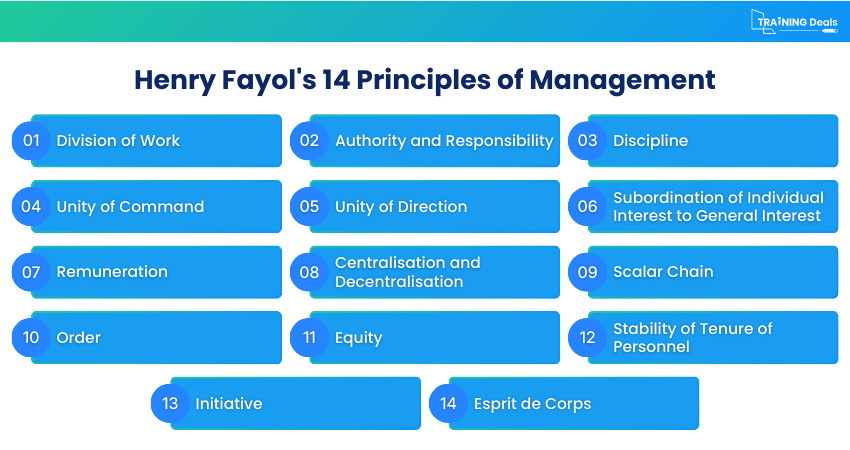
1) Division of Work
The principle of Division of Work states that work should be divided into smaller tasks and assigned according to employee skills and expertise. When employees repeatedly perform a specific type of work, they become more skilled, confident, and faster at completing it. This improves both the quality and speed of output.
Example: In a company, the Human Resources (HR) team manages recruitment, the marketing team promotes products, and the operations team manages production. Because each group concentrates on a particular function, errors are reduced and efficiency increases.
2) Authority and Responsibility
Authority refers to the power to give orders and make decisions, while responsibility refers to accountability for completing assigned tasks. Fayol believed these should go together. A manager needs to have the right to give instructions and make decisions, and at the same time be accountable for the results.
Example: The Marketing Manager is responsible for the success of an advertising campaign and has the authority to select advertising channels, approve designs, and allocate the campaign budget.
3) Discipline
The principle of Discipline means employees and managers should follow organisational rules, respect authority, and maintain proper workplace behaviour. It includes obeying company policies, meeting deadlines, attending work regularly, and behaving professionally with colleagues and supervisors.
Example: The company has a rule that all departments have to submit their weekly reports every Friday. The HR team sends employee updates, the marketing team submits campaign results, and the operations team reports production status on time.
4) Unity of Command
The principle states that an employee should receive instructions from only one supervisor or manager. This avoids confusion and conflict because the employee clearly knows who they report to and whose instructions to follow. When multiple managers give work to the same person, they may face confusion, conflict, and inefficiency with work.
Example: A Marketing Executive reports only to the Marketing Manager. If the Operations Manager needs information, they request it through the Marketing Manager instead of giving direct instructions, so the employee avoids conflicting orders.
Progress to real project application with PRINCE2® Foundation & Practitioner Training – Register today!
5) Unity of Direction
While the principle of Unity of Command deals with individuals, Unity of Direction deals with organisational goals. It focuses on the entire team working toward a single goal using a common strategy. This ensures coordination and prevents duplication of work. It also helps various teams align their work, so overall organisational performance improves.
Example: For a new product launch, the Marketing team creates one promotion plan. Social media posts, advertisements, and email campaigns all follow the same strategy and message, so every activity supports the same goal instead of different teams promoting the product in different ways.
6) Subordination of Individual Interest to General Interest
This principle states that the goals of the organisation should always come before personal goals. Employees may have their own preferences, opinions, or benefits in mind, but they must take organisational goals as a priority. This encourages cooperation and helps teams work together toward common success.
Example: An Operations Supervisor notices increasing customer complaints about delivery timing. They inform the marketing and customer support teams so that all departments can coordinate and improve their service.
7) Remuneration
The principle of Remuneration states that employees should receive fair and reasonable compensation for the work they perform. Remuneration includes not only salary but also incentives, bonuses, benefits, and recognition. The aim is to reward employees in a way that satisfies them while also remaining affordable for the organisation.
Example: The company sets a fixed salary for employees, and the marketing team receives performance bonuses when a campaign increases sales targets. Similarly, the operations team is rewarded for meeting production goals, which motivates employees to perform their work effectively.
8) Centralisation and Decentralisation
This Principle of Management refers to how decision-making authority is distributed within an organisation. Centralisation means important decisions are taken by top management, while decentralisation allows lower-level managers to make decisions related to their departments. Fayol suggested that a proper balance can fit well, depending on the business size and needs.
Example: The company Director decides overall company policies and annual budget (centralisation), while the Marketing Manager chooses advertising methods, and the Operations Manager adjusts production schedules based on daily needs (decentralisation).
9) Scalar Chain
The Scalar Chain principle refers to the clear line of authority and communication in an organisation, from top management to the lowest-level employee. It shows who reports to whom, establishes a proper hierarchy and communication flow. This prevents confusion and ensures messages reach the right person in an organised way.
Example: A production employee notices a machine problem and reports it to the Operations Supervisor. The supervisor then informs the Operations Manager, who updates top management if needed. By following this reporting chain, the issue is handled systematically without bypassing authority levels.
10) Order
This principle means that everything in the organisation should be properly arranged so that work can be carried out smoothly. It includes both physical order and social order. Physical order refers to keeping materials, equipment, and documents in the right place, while social order focuses on assigning tasks to the right person based on skills and qualifications.
Example: The HR team keeps employee records organised in a proper system, the marketing team stores campaign files in shared folders, and the operations department keeps tools and materials arranged in designated areas.
11) Equity
The principle of Equity promotes that employees are treated in a fair manner with respect. Fairness does not always mean identical treatment for everyone, but it means decisions should be unbiased and based on performance, behaviour, and organisational rules. This helps avoid favouritism, discrimination, and harsh behaviour in the workplace.
Example: Employees from different departments receive the same workplace facilities, such as leave benefits and access to resources, according to company policy.
Balance project control and adaptability with PRINCE2 Agile® Foundation and Practitioner Training – Sign up soon!
12) Stability of Tenure of Personnel
This principle emphasises that employees should have reasonable job security and enough time in their roles to learn, improve, and perform effectively. When employees frequently leave or are constantly replaced, the organisation loses experience, and work continuity is disturbed. Job stability helps employees feel secure and encourages them to perform with confidence.
Example: The HR department keeps the same recruiters for multiple hiring cycles, so they become familiar with company requirements and select suitable candidates more efficiently each time.
13) Initiative
This principle of Initiative suggests that employees should be encouraged to think independently, suggest ideas, and take action to improve work processes. Instead of only following instructions, employees are given the opportunity to contribute their creativity and knowledge to the organisation.
Example: A marketing employee suggests using social media promotions to reach more customers. Management accepts the idea, and the campaign brings more enquiries, improving company sales.
14) Esprit de Corps
The principle of Esprit de Corps means promoting team spirit, unity, and cooperation among employees. Fayol believed that harmony in the workplace improves performance because employees work better when they trust and support each other. A friendly and positive environment encourages collaboration rather than competition.
Example: When the operations team faces a heavy workload, the marketing team helps organise product information and documentation, allowing orders to be processed faster and strengthening cooperation among employees.
Why are Fayol’s Principles of Management Important?
Even though Fayol proposed these principles over a century ago, they remain highly relevant. Modern organisations still struggle with communication issues, unclear authority, employee dissatisfaction, and leadership problems. These principles address exactly those challenges. Those principles are important for the following reasons:
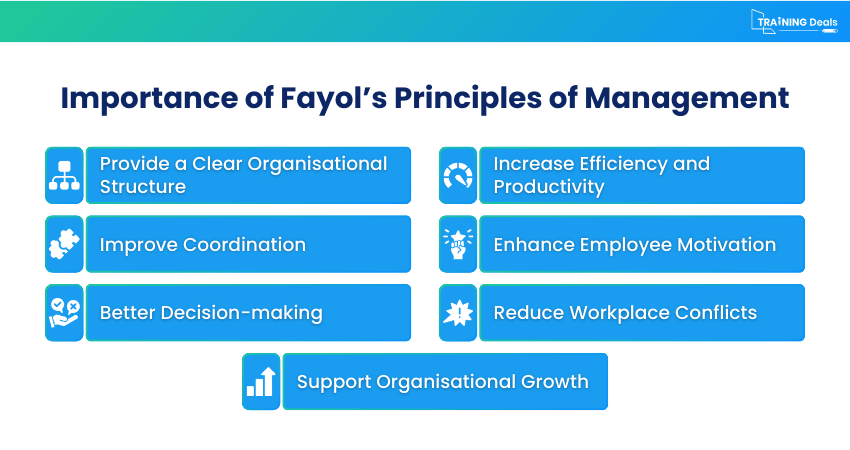
1) Provide a Clear Organisational Structure: They help define roles, responsibilities, and authority levels, so employees know who is responsible for each task and whom to report to.
2) Improve Coordination: They guide departments to follow common plans and proper communication channels so teams can work together smoothly.
3) Better Decision-making: They provide managers with a clear framework that helps them make consistent and balanced workplace decisions.
4) Increase Efficiency and Productivity: Proper division of work and organised processes help employees complete tasks faster with fewer errors.
5) Enhance Employee Motivation: Fair treatment, recognition, and suitable remuneration encourage employees to work sincerely and stay committed.
6) Reduce Workplace Conflicts: Clear authority and communication reduce misunderstandings and prevent disputes among employees and departments.
7) Support Organisational Growth: They help organisations maintain control and coordination as the company expands.
Conclusion
The Principles of Management provide a clear and practical foundation for managing any organisation effectively. Henri Fayol’s 14 principles explain how managers can organise work, guide employees, maintain discipline, and encourage teamwork in a structured way. By applying these principles, businesses can reduce confusion, improve productivity, and create a positive work environment.
Learn how successful projects are planned and controlled with PRINCE2® Training – Join now!
Search
- PRINCE2 vs APM: A Complete Guide to their Differences
- 10+ Project Management Tools to Boost Productivity in 2026
- What is Scrum? Agile Framework Explained
- What is Project Management? Phases, Approaches, and Benefits
- What is Agile Project Management? A Comprehensive Guide
- What are Project Management Skills: Top 25+ Skills You Must Know
- AI in Project Management: Benefits, Challenges, and Best Practices
- What is the Critical Path Method in Project Management? Explained
- What is Project Management Triangle? Key 3 Constraints Explained
- ITIL Framework: Definition, Benefits and Implementation Explained
- What is Workflow Management? A Comprehensive Guide
- What is a Project Management Plan? Key Components and Benefits
- Why is Project Management Important? Top 12 Reasons & Tips
- Top 15 Project Management Methodologies You Should Know in 2026
- 15 Project Management Techniques Every Manager Should Use
- Project Timeline Explained: Simple Steps to Create Effective Plans
- How to Become a Project Manager: Skills, Steps, and Career Path
- Project Charter Explained: Components & How to Write It Effectively
- Program Manager vs Project Manager: A Complete Comparison Guide
- The 5 Project Management Phases Every Professional Should Know
- What is Risk Mitigation: Types, Steps, and Best Practices
No match found
Latest Blog
What is Risk Mitigation: Types, Steps, and Best Practices
June 27, 2026
The 5 Project Management Phases Every Professional Should Know
June 23, 2026
Program Manager vs Project Manager: A Complete Comparison Guide
June 23, 2026
Project Charter Explained: Components & How to Write It Effectively
June 23, 2026
FAQ
No FAQs available for this blog.
.svg)