.svg)


AI in Project Management: Benefits, Challenges, and Best Practices
AI in Project Management uses automation and data insights to plan, track, and optimise projects efficiently. It brings greater control to the project. By reducing risks and improving decisions, AI helps teams manage resources better, enabling Project Managers to deliver faster results and achieve higher success rates.
Maria Thompson
Projects today deal with shifting deadlines, increasing workloads, and complex decisions that traditional approaches often struggle to manage. AI in Project Management helps teams predict risks, automate routine tasks, and make faster, smarter decisions. By strengthening planning, execution, and monitoring, Artificial Intelligence (AI) brings greater clarity, efficiency, and control to project delivery.
In this blog, you will learn what AI in Project Management is, why organisations use it, its key types, benefits, and best practices. Discover how AI is reshaping Project Management through practical, real-world applications. Read on to learn more.
What is AI in Project Management?
AI in Project Management refers to the use of Artificial Intelligence technologies, such as Machine Learning (ML), predictive analytics, and Natural Language Processing (NLP), to enhance how projects are planned, executed, and monitored. It analyses project data to support scheduling, resource planning, risk management, and performance tracking, enabling more accurate, data-driven decisions.
AI automates routine tasks, predicts issues, and optimises workflows. Integrated into Project Management tools, it improves efficiency and decision-making, allowing managers to focus more on strategy and value delivery.
Why Use AI for Project Management?
AI improves Project Management by automating tasks, analysing data, and supporting smarter decisions. It reduces manual work, predicts risks, and enhances planning. Key reasons for using AI in Project Management include: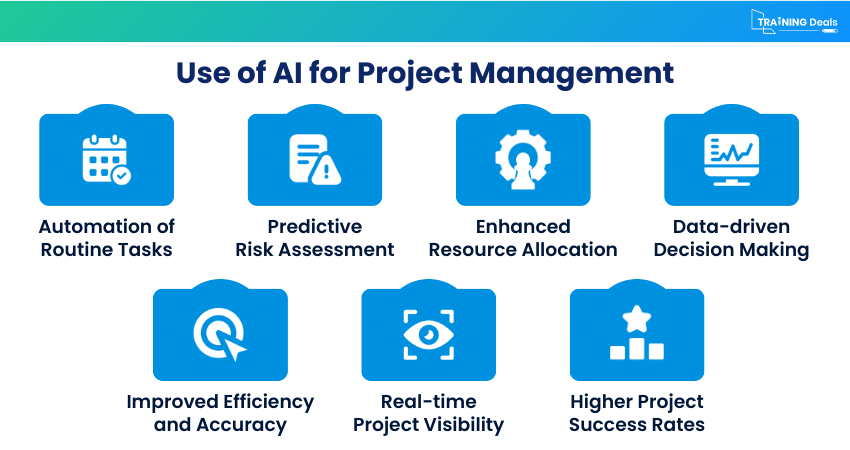
1) Automation of Routine Tasks: AI automates repetitive activities like task updates, scheduling, reporting, and reminders, reducing manual effort and saving time.
2) Predictive Risk Assessment: AI analyses historical and real-time data to predict risks, delays, and budget overruns, enabling proactive risk management.
3) Enhanced Resource Allocation: AI optimises resource planning by matching skills to tasks, forecasting workload, and preventing team burnout.
4) Data-driven Decision Making: AI provides real-time insights, accurate cost estimates, and actionable data to support faster and smarter decisions.
5) Improved Efficiency and Accuracy: By reducing human errors, AI increases data accuracy and speeds up project execution.
6) Real-time Project Visibility: AI offers a complete view of project performance, helping managers track progress and manage multiple projects effectively.
7) Higher Project Success Rates: By improving planning, monitoring, and optimisation, AI increases the chances of delivering projects on time and within budget.
Types of AI Solutions for Project Management
Artificial Intelligence in Project Management uses multiple intelligent solutions, not a single technology. Each type improves project outcomes, as discussed below: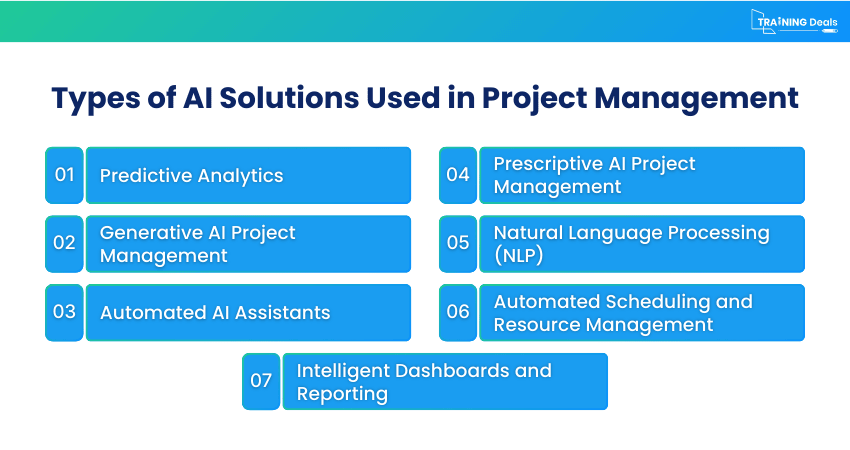
1) Predictive Analytics
Predictive analytics uses AI to analyse historical and real-time project data to forecast future outcomes. It helps Project Managers predict project performance, resource utilisation, potential delays, and budget risks before they occur.
For example, predictive models can estimate schedule delays based on factors like workload, past performance, or external conditions. By identifying risks early, predictive analytics enables proactive planning and better control over project outcomes.
2) Generative AI Project Management
Generative AI uses advanced algorithms to create project-related content, insights, and recommendations. In Project Management, it can generate project plans, timelines, reports, risk assessments, and communication drafts based on available data.
Generative AI supports brainstorming, documentation, and strategy development by offering intelligent suggestions. Automating content creation and analysis helps Project Managers save time, improve accuracy, and make better decisions across the project lifecycle.
3) Automated AI Assistants
Automated AI assistants act as digital helpers that support Project Managers with routine tasks. They automate reminders, task updates, progress tracking, team notifications, and report generation, reducing administrative workload and helping teams stay organised and informed.
They improve communication and workflows by handling repetitive tasks. This allows Project Managers to concentrate on strategic activities like risk management and stakeholder coordination, making Project Management more efficient and productive.
4) Prescriptive AI Project Management
Prescriptive AI Project Management goes beyond predicting problems by recommending specific actions to address them. Instead of only identifying risks or delays, it suggests solutions such as reallocating resources, adjusting timelines, or changing task priorities.
These tools turn project data into actionable strategies, helping teams respond quickly to change. Acting as a digital advisor, prescriptive AI enables smarter decisions and better outcomes, making it valuable in complex and dynamic project environments.
5) Natural Language Processing (NLP)
Natural Language Processing (NLP) helps AI understand language in emails, messages, meetings, and documents. It extracts action items, key topics, and sentiment trends, helping Project Managers better understand team dynamics and stakeholder expectations.
By identifying communication gaps and team sentiment, NLP improves collaboration and decision-making. It also helps Project Managers respond quickly to issues, enhance transparency, and maintain better alignment across teams.
6) Automated Scheduling and Resource Management
Automated scheduling and resource management use AI to optimise project timelines and resource allocation. AI-driven tools analyse multiple factors such as workload, skills, availability, priorities, and dependencies to dynamically adjust schedules and assign resources efficiently.
For example, AI can reallocate tasks when team members are unavailable or when workloads change. This ensures optimal resource use, reduces delays, and improves overall project efficiency and team productivity.
7) Intelligent Dashboards and Reporting
Intelligent dashboards and reporting use AI to provide real-time insights into project performance. Instead of static reports, AI collects data from various sources and presents it in a consolidated, visual format.
These dashboards highlight Key Performance Indicators (KPIs), risks, and anomalies that require attention. By offering real-time visibility and actionable insights, intelligent dashboards help Project Managers monitor progress, make informed decisions, and improve project outcomes.
Boost your Project Management skills by combining Agile practices with PRINCE2 principles through the PRINCE2 Agile® Foundation Training - Join now!
Benefits of Using AI for Project Management
AI enhances efficiency, accuracy, and collaboration while reducing risks and costs in Project Management. The key benefits of AI are explained below:
1) Improved Decision Making
AI improves decision-making by transforming complex project data into clear, actionable insights. Instead of relying only on intuition, Project Managers can use real-time data on schedules, budgets, and team performance to understand project status accurately.
AI-powered tools highlight priorities, predict outcomes, and suggest improvements, helping managers make faster, more informed decisions and reduce unexpected issues during project execution.
2) Enhanced Risk Management
AI strengthens risk management by continuously analysing project data to identify potential risks. It assesses the likelihood and impact of issues such as delays, cost overruns, or resource shortages and recommends mitigation strategies.
By enabling proactive risk management, AI helps teams address problems early, avoid disruptions, and maintain project stability even in changing conditions and complex project environments.
3) Automated Reporting
AI automates the creation of project reports, dashboards, and performance summaries. Instead of manually compiling data, Project Managers can generate accurate, real-time reports in seconds.
AI tools collect information from multiple sources, ensuring that reports are always up to date. This saves time, improves transparency, and keeps stakeholders aligned without additional manual effort.
4) Scalability
AI enables Project Management to scale easily as projects grow in size and complexity. Whether managing a single project or an entire portfolio, AI tools can handle increasing data, tasks, and resources effectively.
By automating monitoring and analysis, AI allows organisations to expand operations without losing control or visibility. Teams remain efficient and productive even as workloads increase and project complexity grows.
5) Improved Communication
AI improves communication in Project Management by analysing messages, feedback, and collaboration data across teams. It identifies communication gaps, highlights key updates, and ensures relevant information reaches the right stakeholders on time.
By using technologies like NLP, AI can extract insights from emails, chats, and reports, improving transparency and alignment. This leads to better collaboration, faster responses, and stronger coordination among project teams.
6) Optimised Resource Allocation
Optimised resource allocation is one of the key benefits of Artificial Intelligence in Project Management. AI analyses project requirements, team skills, workloads, and resource availability to allocate resources more effectively.
By matching the right people and resources to the right tasks, AI reduces inefficiencies, prevents overloading, and improves productivity. It also helps Project Managers anticipate future resource needs, ensuring balanced workloads and better project outcomes.
7) Automated Task Management
Automated task management uses AI to streamline essential project activities such as task assignment, progress tracking, scheduling, and status updates. AI-driven automation reduces manual effort and ensures that tasks are managed consistently and accurately.
By automating routine task management processes, AI improves workflow efficiency and allows project teams to focus on high-value activities such as problem-solving, innovation, and stakeholder engagement.
Upgrade your Project Management skills with the PRINCE2® Practitioner Training and real-world application knowledge – Join today!
Challenges in Using AI for Project Management
Despite its benefits, AI for Project Management also presents key challenges that organisations must address. The main challenges are explained below:
1) Dependence on Data Quality
AI Project Management relies heavily on data to generate insights and predictions. If project data is incomplete, outdated, or inaccurate, AI tools may produce misleading recommendations and incorrect forecasts.
To ensure reliable results, organisations must maintain high-quality data through disciplined data entry, regular updates, and strong data governance. Without accurate data, the effectiveness of AI-driven Project Management can be significantly reduced.
2) Reduced Human Oversight
Automation can sometimes reduce human involvement in Project Management decisions. Over-reliance on AI-generated insights may cause teams to overlook important contextual factors that technology cannot fully interpret.
AI should support, not replace, human judgment. Regular reviews, discussions, and strategic oversight are essential to ensure that AI-driven decisions align with organisational goals and project objectives.
3) Data Privacy and Security
AI Project Management tools often require access to sensitive organisational data, including financial information, employee details, and strategic plans. This raises concerns about data privacy and Cyber Security risks.
Organisations must implement strong security measures, choose reliable vendors, and train employees in secure data handling practices. Protecting sensitive data is essential to building trust and ensuring safe AI adoption.
4) High Implementation and Maintenance Costs
Implementing AI in Project Management can involve high initial costs for software, integration, infrastructure, and training. Ongoing maintenance and updates can also add to long-term expenses.
For smaller teams, these costs may be challenging. However, careful planning, phased implementation, and clear Return on Investment (ROI) evaluation can help organisations manage expenses and maximise the value of AI investments.
Best Practices for Implementing AI in Project Management
To maximise the benefits of AI, organisations should adopt the right strategies and approaches during implementation. The key best practices are outlined below: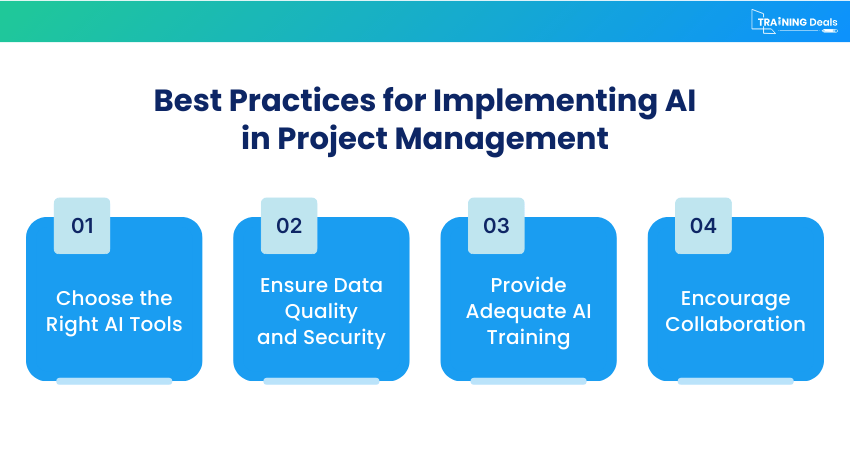
Choose the Right AI Tools
Selecting the right AI tools is crucial for effective implementation. With many AI solutions available, organisations should choose tools that align with their specific Project Management needs and goals.
It is also important to select tools that integrate easily with existing systems and workflows. The right tools enhance efficiency, improve adoption, and ensure that AI delivers meaningful value across projects.
Ensure Data Quality and Security
AI systems depend on accurate, complete, and secure data to function effectively. Poor-quality data can lead to unreliable insights and incorrect decisions, reducing the overall effectiveness of AI-driven Project Management.
Organisations should implement strong data governance policies, maintain regular data updates, and adopt security measures to protect sensitive information. Ensuring data quality and security is essential for building trust in AI-driven Project Management.
Provide Adequate AI Training
Adequate training is important for successful AI adoption. Even the most user-friendly AI tools require proper understanding to be used effectively across teams and project workflows and processes.
Organisations should provide training programmes, tutorials, and learning resources to help Project Managers and teams use AI tools confidently. Well-trained teams can maximise the benefits of AI and improve overall project performance.
Encourage Collaboration
AI should support collaboration, not replace it. Effective Project Management depends on strong communication and cooperation among teams, stakeholders, and decision-makers across complex project environments.
Organisations should choose AI tools that facilitate collaboration and transparency. By combining AI insights with human expertise and teamwork, organisations can achieve better project outcomes and more strategic decision-making.
Strengthen your understanding of structured Project Management by joining the PRINCE2® Foundation Training now!
Top AI Project Management Tools
Several AI-powered tools are transforming Project Management through automation, collaboration, and insights. Key tools are mentioned below:
1) Motion
Motion is an AI-driven scheduling and productivity tool that automatically plans tasks and meetings based on priorities, deadlines, and workload. It dynamically adjusts schedules when priorities change, helping teams manage time more effectively.
By automating planning and prioritisation, Motion reduces manual effort and ensures that important tasks are completed on time, making it ideal for fast-paced and dynamic project environments.
2) ClickUp
ClickUp is a comprehensive Project Management platform with built-in AI capabilities for task automation, workflow optimisation, and intelligent reporting. It helps teams manage projects, track progress, and collaborate in a single workspace.
With AI-powered insights and automation, ClickUp improves productivity, enhances visibility, and supports data-driven decision-making across projects, helping teams streamline workflows and deliver results more efficiently.
3) Trello
Trello is a visual Project Management tool that uses AI-powered automation and integrations to streamline workflows. It helps teams organise tasks using boards, lists, and cards, making project tracking simple and intuitive.
AI features in Trello help automate repetitive actions, improve task management, and enhance team collaboration, making it suitable for Agile and small-to-medium projects with flexible workflows and evolving requirements.
4) Notion
Notion is a flexible workspace tool that integrates AI for documentation, knowledge management, and project collaboration. Its AI features help generate content, summarise information, and organise project data efficiently.
By combining project planning with intelligent documentation, Notion improves team communication, reduces manual work, and supports better project organisation, knowledge sharing, and collaboration across teams.
5) Asana
Asana is one of the popular Project Management tools that uses AI to optimise workflows, track project performance, and improve resource management. It provides intelligent insights into task dependencies, timelines, and team workloads.
With AI-driven analytics and automation, Asana helps teams stay aligned, manage complex projects, and deliver results more effectively while improving visibility, coordination, and overall project performance.
The Future of AI in Project Management
AI is transforming Project Management from a manual, administrative function into a strategic, data-driven discipline. With Gartner predicting that 80% of current Project Management tasks could be managed by AI by 2030, organisations are increasingly relying on AI to improve efficiency and decision-making.
Future trends include AI-powered predictive analytics, automated scheduling, resource optimisation, and cognitive assistants that enhance risk management and strategic planning. As AI evolves, Project Management will become faster, smarter, and more proactive, enabling teams to deliver projects with greater accuracy and confidence.
Conclusion
AI in Project Management helps teams plan better, reduce risks, and manage work more efficiently. By automating routine tasks and providing useful insights, it supports faster decisions and better use of resources. When combined with human judgment, AI helps organisations deliver projects smoothly and achieve consistent success.
Enhance your ability to plan and control projects effectively with the PRINCE2® Training – Join now!
Search
- PRINCE2 vs APM: A Complete Guide to their Differences
- 10+ Project Management Tools to Boost Productivity in 2026
- What is Scrum? Agile Framework Explained
- What is Project Management? Phases, Approaches, and Benefits
- What is Agile Project Management? A Comprehensive Guide
- What are Project Management Skills: Top 25+ Skills You Must Know
- What is the Critical Path Method in Project Management? Explained
- What is Project Management Triangle? Key 3 Constraints Explained
- What are the Principles of Management? A Complete Overview
- ITIL Framework: Definition, Benefits and Implementation Explained
- What is Workflow Management? A Comprehensive Guide
- What is a Project Management Plan? Key Components and Benefits
- Why is Project Management Important? Top 12 Reasons & Tips
- Top 15 Project Management Methodologies You Should Know in 2026
- 15 Project Management Techniques Every Manager Should Use
- Project Timeline Explained: Simple Steps to Create Effective Plans
- How to Become a Project Manager: Skills, Steps, and Career Path
- Project Charter Explained: Components & How to Write It Effectively
- Program Manager vs Project Manager: A Complete Comparison Guide
- The 5 Project Management Phases Every Professional Should Know
- What is Risk Mitigation: Types, Steps, and Best Practices
No match found
Latest Blog
What is Risk Mitigation: Types, Steps, and Best Practices
June 27, 2026
The 5 Project Management Phases Every Professional Should Know
June 23, 2026
Program Manager vs Project Manager: A Complete Comparison Guide
June 23, 2026
Project Charter Explained: Components & How to Write It Effectively
June 23, 2026
FAQ
No FAQs available for this blog.
.svg)