.svg)


Project Charter Explained: Components & How to Write It Effectively
A Project Charter is a document that defines project objectives, scope, stakeholders, and resources, providing clear direction and authority to begin work. It ensures stakeholders are aligned on expectations and responsibilities from the start, while guiding decisions and keeping the project focused on defined goals and outcomes.

David Walter
Have you ever worked on a project like launching a website, planning a marketing campaign, or organising an event, only to realise halfway that everyone is not on the same page? Deadlines slip, roles become unclear, and simple tasks turn into confusion. This is what happens when a Project Charter is missing from the start.
That is where a Project Charter becomes essential in setting a clear direction for the entire project. It brings everyone together by defining goals, roles, and expectations early, helping teams avoid mistakes and stay focused. In this blog, you will explore its key components, purpose, and how to create one effectively. Let's begin!
What is a Project Charter?
A Project Charter is a concise, formal document that officially authorises a project and defines its purpose, scope, and key objectives. It outlines important details such as stakeholders, constraints, and expected outcomes to ensure everyone involved has a clear understanding from the start.
It also provides the Project Managers with the authority to use organisational resources and begin work. In a Project Charter, elements like the business case, return on investment, and major risks are often highlighted, helping stakeholders stay aligned and guiding the project in the right direction.

What is the Purpose of a Project Charter?
The purpose of a Project Charter is to set clear direction, structure, and guidelines for a project while ensuring stakeholder alignment from the start. It acts as a reference point that helps teams avoid mistakes and manage challenges by defining key aspects such as:
1) Project Direction and Framework: Provides a clear structure that guides the project from initiation to completion.
2) Supporting Data and Key Details: Includes all necessary information required to plan and execute the project effectively.
3) Potential Challenges and Objections: Identifies risks like budget limits, resource constraints, or technical issues early on.
4) Stakeholder Alignment and Communication: Ensures transparency and keeps everyone informed about expectations and responsibilities.
5) Business Value and ROI: Demonstrates the project’s importance and helps gain stakeholder approval and support.
Why is a Project Charter Important?
A Project Charter is important because it formally authorises a project, aligns stakeholders, and establishes a clear direction from the outset. It acts as a guiding document that ensures everyone involved understands the project’s purpose, scope, and expected outcomes.
1) Informs the Team: Provides essential details like scope, timeline, and deliverables for better understanding.
2) Highlights Project Value: Connects project goals with organisational objectives and expected outcomes.
3) Creates a Link to Portfolio Management: Aligns the project with the overall business strategy and performance tracking.
4) Prevents Scope Creep: Defines clear boundaries to avoid uncontrolled changes and delays.
5) Establishes a Timeline: Sets expectations for milestones and deadlines across the project lifecycle.
6) Defines Success Criteria: Establishes measurable benchmarks to evaluate project performance and outcomes.
Learn essential project skills for real-world success with the PRINCE2® Foundation Training – Register soon!
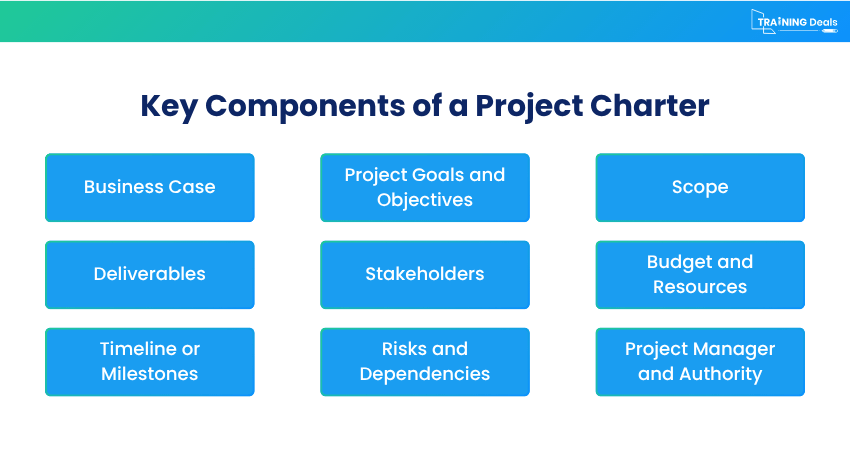
Key Components of a Project Charter
Understanding the key components of a Project Charter ensures that all essential details are included and provides a clear direction for the project. Each element plays a vital role in defining scope, expectations, and execution. Together, these components create a strong foundation for effective planning and successful delivery.
1) Business Case
The business case explains why the project is needed and the value it will deliver to the organisation. It outlines the problem being addressed and justifies the investment required.
A strong business case highlights expected benefits, costs, and risks. This helps stakeholders understand the project’s importance and supports informed decision-making before approval is granted.
2) Project Goals and Objectives
Project goals and objectives define what the project aims to achieve. They provide direction and measurable outcomes that keep teams aligned throughout the lifecycle.
In a Project Charter, objectives should follow the SMART approach (Specific, Measurable, Achievable, Relevant, and Time-bound). This ensures progress can be tracked effectively and results are meaningful.
3) Scope
The scope specifies what is included and excluded in the project. It sets clear boundaries, helping teams understand the work required and preventing scope creep during the project execution phase.
A well-defined scope in a Project Charter ensures clarity and reduces misunderstandings. It allows teams to focus on delivering agreed outcomes while avoiding unnecessary changes that may impact time, cost, or quality.
4) Deliverables
Deliverables are the tangible outputs that the project will produce throughout its lifecycle. They represent the results of the work completed and are essential for measuring the success of the project.
In a Project Charter, deliverables should be clearly defined and aligned with project objectives. This helps stakeholders understand what to expect and ensures that all outputs meet the required standards and expectations.
5) Stakeholders
Stakeholders are individuals or groups who have an interest in the project or are directly affected by its outcomes and results. Identifying stakeholders is essential for effective communication and collaboration.
A Project Charter outlines key stakeholders and their roles. This makes sure that everyone involved understands their responsibilities, improves engagement, and helps manage expectations throughout the project lifecycle effectively.
6) Budget and Resources
Budget and resources define the financial and human requirements needed to complete the project successfully. This includes funding, team members, tools, and equipment required for execution.
A Project Charter provides an overview of available resources and estimated costs. This helps ensure proper planning, avoids resource shortages, and supports efficient allocation throughout the project lifecycle.
7) Timeline or Milestones
The timeline outlines the schedule for completing the project, including key milestones and important deadlines throughout its duration. It helps teams understand timelines clearly and track progress effectively across different stages of the project lifecycle.
Including milestones in a Project Charter provides checkpoints to measure progress. This ensures the project stays on track and enables early identification of delays or issues.
8) Risks and Dependencies
The timeline outlines the schedule for completing the project, including key milestones and important deadlines throughout its duration. It helps teams understand timelines clearly and monitor progress efficiently across all stages of the project lifecycle.
A Project Charter includes high-level risks and dependencies to support proactive planning. This helps teams prepare for potential issues and ensures smoother execution by addressing challenges early in the project lifecycle.
9) Project Manager and Authority
The Project Manager is responsible for leading the project and ensuring its successful delivery from initiation to completion. Their authority defines decision-making power and accountability within the project structure.
In a Project Charter, clearly defining the Project Manager’s role ensures accountability and effective leadership. It helps streamline communication, improve coordination, and ensure that decisions are made efficiently throughout the project lifecycle.
Gain confidence in managing flexible project environments with the PRINCE2 Agile® Foundation Training – Register today!
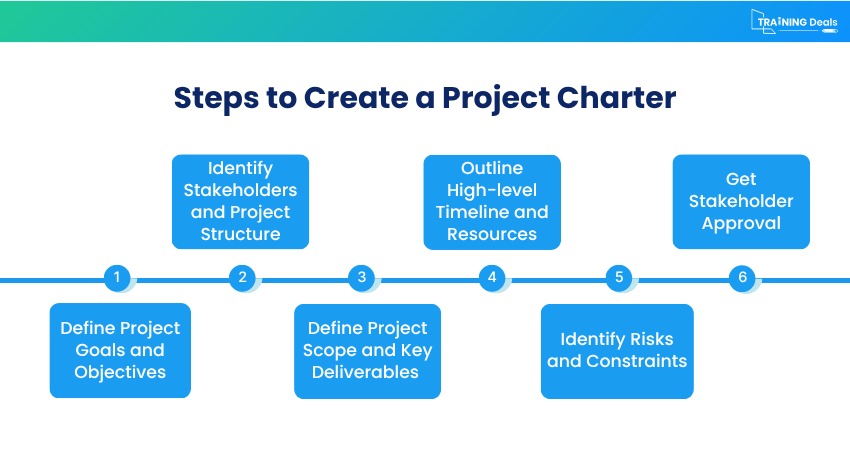
How to Write a Project Charter?
Writing a Project Charter requires a structured approach to ensure all essential details are included. Following clear steps helps create a comprehensive document that supports project success and stakeholder alignment:
Step 1: Define Project Goals and Objectives
Start by clearly defining what the project goals are. Identify specific goals and measurable objectives that align with organisational priorities and stakeholder expectations, ensuring clarity from the beginning of the Project Charter process.
Including clear goals in a Project Charter ensures the project has a defined purpose. It helps teams stay focused, guides decision-making, and provides a reliable benchmark for measuring progress and success throughout the entire project lifecycle.
Step 2: Identify Stakeholders and Project Structure
Next, identify all stakeholders involved in the project and define the project structure. This includes outlining roles, responsibilities, and reporting relationships to ensure clarity and accountability within the Project Charter from the early planning stages.
A well-structured Project Charter improves communication and collaboration among stakeholders. It reduces confusion, strengthens coordination, and ensures that everyone clearly understands their involvement, responsibilities, and expectations throughout the project lifecycle and execution process.
Step 3: Define Project Scope and Key Deliverables
Clearly outline what the project will include and exclude. Defining boundaries helps prevent scope creep and ensures that all activities remain aligned with agreed objectives within the Project Charter throughout the project lifecycle.
Defining deliverables in the Project Charter ensures clarity on expected outputs. It helps stakeholders understand what will be produced, maintains alignment with project goals, and ensures that all outcomes meet required standards and expectations effectively.
Step 4: Outline High-level Timeline and Resources
Establish a high-level timeline that includes major milestones and deadlines. Identify required resources such as team members, tools, and budget to ensure smooth planning and execution within the Project Charter framework.
A Project Charter with a clear timeline and resources supports effective planning. It helps teams manage schedules efficiently, allocate resources appropriately, and minimise delays, ensuring that the project progresses smoothly and meets defined deadlines successfully.
Step 5: Identify Risks and Constraints
Identify risks and constraints that may impact the project. This includes limited resources, time restrictions, or external dependencies that could influence progress and overall success outlined within the Project Charter.
Including risks in the Project Charter enables proactive planning and preparedness. It helps teams anticipate challenges, develop mitigation strategies, and ensure smoother execution by addressing potential issues early and reducing disruptions throughout the project lifecycle.
Step 6: Get Stakeholder Approval
Once the Project Charter is completed, it should be reviewed and approved by key stakeholders. This ensures alignment on objectives, scope, and expectations before moving forward with project execution and implementation.
Approval finalises the Project Charter and officially authorises the project to begin. It confirms stakeholder agreement, strengthens commitment, and provides a clear, approved foundation that guides the project towards successful and structured delivery.
Advance your Project Management skills with practical application. Join for the PRINCE2® Practitioner Training – Join now!
Project Charter Examples
A Project Charter example shows how key project details are structured in practice, combining objectives, scope, stakeholders, timeline, and risks into one document. For example, a website redesign charter outlines goals, deliverables, and milestones clearly:
Company: ABC Project Charter
Project Name: Website Redesign for Improved User Experience
Project Description: Redesign the company website to enhance user experience, improve navigation, and increase conversion rates across key service pages.
Business Case: Supports organisational goals by:
1) Increasing website conversions by 20%
2) Improving customer engagement and retention
3) Strengthening brand presence online
Project Deliverables:
1) Redesigned website layout and interface
2) Updated content and visuals
3) Mobile-responsive website
4) Final website launch
Project Benefits:
1) Improved user experience
2) Higher conversion rates
3) Better brand visibility
4) Increased customer satisfaction
Project Risks:
1) Delays in design approvals
2) Technical issues during development
3) Limited resources or budget constraints
Project Budget: Not to exceed £8,000
Project Milestones:
1) Design approval: March 10, 2026
2) Development completion: April 5, 2026
3) Testing phase: April 15, 2026
4) Website launch: April 25, 2026
Project Team Members:
1) Project Manager: Alex R.
2) Web Designer: Mia T.
3) Developer: John L.
4) Content Writer: Sara P.
5) QA Tester: David K.
This example shows how a Project Charter clearly outlines all essential details, helping teams stay aligned and execute the project effectively from start to finish.
Common Project Charter Mistakes
A Project Charter can fail to deliver value if it is poorly defined or not aligned with stakeholder expectations. Common mistakes such as vague goals, unclear scope, and lack of stakeholder input often lead to confusion and poor project outcomes. Some of the most common mistakes include:
1) Vague Goals: Unclear objectives make it difficult to guide the project and measure success effectively.
2) Undefined Scope: Lack of clear boundaries can result in scope creep and uncontrolled changes.
3) Missing Stakeholder Input: Ignoring key stakeholders leads to misalignment and weak support.
4) Ignoring Risks: Failing to identify risks early can cause unexpected challenges during execution.
5) Assuming Resources: Planning without confirming resources may lead to delays and inefficiencies.
6) Unrealistic Timelines: Setting impractical deadlines can impact quality and project delivery.
7) Overly Complex or Weak Charter: Too much or too little detail reduces usability and clarity.
8) Lack of Approval: An unapproved Project Charter lacks authority and proper governance.
Deliver projects efficiently with flexible and practical methods through the PRINCE2 Agile® Foundation and Practitioner Training – Join today!
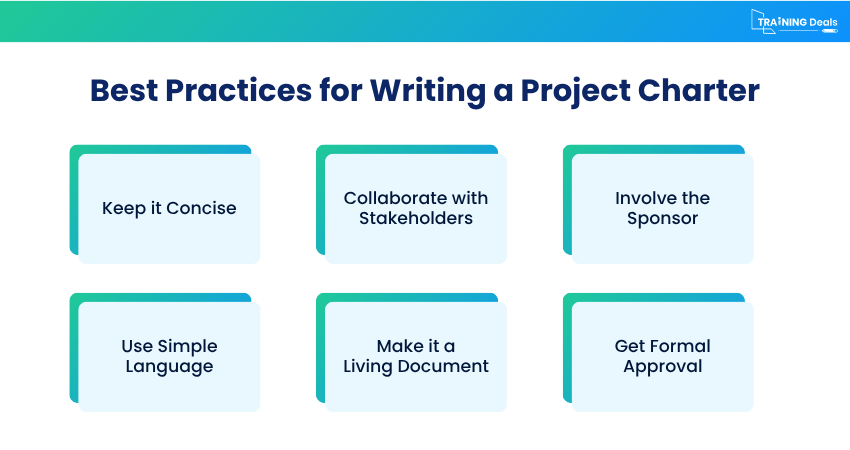
Best Practices for Writing a Project Charter
Following best practices ensures that a Project Charter is clear, effective, and useful for guiding the project. A well-written charter improves alignment, supports decision-making, and helps teams start with a strong foundation. Some key best practices include:
1) Keep it Concise: Limit the Project Charter to one to three pages, focusing on key details rather than creating a detailed project plan.
2) Collaborate with Stakeholders: Involve key stakeholders during drafting to ensure alignment, gather input, and build early support for the project.
3) Involve the Sponsor: Work closely with the project sponsor, as they play a key role in authorising the project and guiding its direction.
4) Use Simple Language: Avoid complex terms and jargon so that everyone in the organisation can clearly understand the project purpose.
5) Make it a Living Document: Review and update the Project Charter if major changes occur during the project lifecycle.
6) Get Formal Approval: Ensure the sponsor signs off on the Project Charter to officially authorise the project and confirm the Project Manager’s authority.
Conclusion
A well-crafted Project Charter provides a strong foundation for project success by ensuring clarity, alignment, and direction from the start. It defines goals, scope, and responsibilities, helping teams stay focused and avoid risks. When created effectively, it supports better decisions, smoother execution, and successful project outcomes.
Build practical Project Management skills and advance your career with the PRINCE2® Training – Join now!
Search
- PRINCE2 vs APM: A Complete Guide to their Differences
- 10+ Project Management Tools to Boost Productivity in 2026
- What is Scrum? Agile Framework Explained
- What is Project Management? Phases, Approaches, and Benefits
- What is Agile Project Management? A Comprehensive Guide
- What are Project Management Skills: Top 25+ Skills You Must Know
- AI in Project Management: Benefits, Challenges, and Best Practices
- What is the Critical Path Method in Project Management? Explained
- What is Project Management Triangle? Key 3 Constraints Explained
- What are the Principles of Management? A Complete Overview
- ITIL Framework: Definition, Benefits and Implementation Explained
- What is Workflow Management? A Comprehensive Guide
- What is a Project Management Plan? Key Components and Benefits
- Why is Project Management Important? Top 12 Reasons & Tips
- Top 15 Project Management Methodologies You Should Know in 2026
- 15 Project Management Techniques Every Manager Should Use
- Project Timeline Explained: Simple Steps to Create Effective Plans
- How to Become a Project Manager: Skills, Steps, and Career Path
- Program Manager vs Project Manager: A Complete Comparison Guide
- The 5 Project Management Phases Every Professional Should Know
- What is Risk Mitigation: Types, Steps, and Best Practices
No match found
Latest Blog
What is Risk Mitigation: Types, Steps, and Best Practices
June 27, 2026
The 5 Project Management Phases Every Professional Should Know
June 23, 2026
Program Manager vs Project Manager: A Complete Comparison Guide
June 23, 2026
Project Charter Explained: Components & How to Write It Effectively
June 23, 2026
FAQ
Yes, a Project Charter can be used in Agile projects, but it is usually simpler and more flexible. It provides a high-level overview of goals, scope, and stakeholders, helping teams stay aligned while still allowing iterative development and continuous changes.
A good Project Charter is a concise document that authorises a project and aligns stakeholders. It defines the purpose, scope, roles, and key goals clearly. It also includes elements like budget, risks, and milestones, providing direction without unnecessary detail.
A Project Charter is a high-level document that authorises a project and defines its purpose and scope. A project proposal comes before it to gain approval, while a project plan follows it, detailing how the project will be executed.
.svg)