.svg)


Program Manager vs Project Manager: A Complete Comparison Guide
Compare Program Managers vs Project Managers, where one focuses on strategy and multiple projects, while the other focuses on execution and deliverables. Understanding the difference between them helps organisations assign the right responsibilities, improve efficiency, and align work with long-term business goals.
Hailey Davis
In many organisations, success depends on both strong planning and effective execution, yet the roles behind these functions are often misunderstood. This becomes clearer when comparing Program Manager vs Project Manager, the difference is in how each role drives outcomes. One focuses on the bigger picture, while the other ensures every detail is delivered on time.
Understanding the differences between a Program Manager vs Project Manager can help you manage work more efficiently and avoid confusion across teams. In this blog, you will learn what a Program Manager and a Project Manager are, along with the key differences between them. Let’s explore further!
What is a Program Manager?
A Program Manager is a professional who is responsible for overseeing the lifecycle of a program made up of multiple related projects. Their focus is to ensure that these projects are aligned with organisational goals and deliver long-term value.
They work closely with Project Managers, Portfolio Managers, teams, and stakeholders to coordinate efforts and maintain alignment across all projects within the program. This helps organisations to achieve their strategic objectives more efficiently.
The Responsibilities of a Program Manager
A Program Manager plays a crucial part in ensuring that multiple projects are aligned and contribute to overall business goals. Let’s look at their key responsibilities below:
Key Responsibilities:
a) Oversee multiple related projects within a program
b) Coordinate and provide direction to Project Managers and project teams
c) Ensure the successful delivery of program outcomes
d) Develop and execute program management plans
e) Establish project selection and prioritisation criteria
f) Align programs with organisational strategic goals
g) Allocate and schedule resources across projects
h) Collaborate with Project Management Office (PMOs), Functional Managers, and senior leadership
i) Support project portfolio optimisation for better value delivery

What is a Project Manager?
A Project Manager is a Project Management professional who oversees the lifecycle of a project from start to finish. Their primary focus is to ensure the project is completed on time, within scope, and meets its objectives.
They are responsible for creating a project plan, managing the team’s workload, and monitoring key constraints such as time, cost, and resources to ensure successful delivery. This is useful for keeping the project on track and ensuring expected outcomes are achieved efficiently.
The Responsibilities of a Project Manager
A Project Manager is responsible for planning, executing, and delivering a project successfully within defined constraints. Let’s look at their key responsibilities below:
Key Responsibilities:
a) Manage project constraints such as cost, time, scope, quality, risk, and resources
b) Assemble and manage the project team and monitor their performance
c) Ensure successful project delivery within the set time and budget
d) Create and execute the Project Management plan
e) Report project status to Program Managers, PMOs, and stakeholders
f) Monitor team workload to maintain productivity
g) Establish project controls to track progress and project health
h) Manage and maintain project documentation
i) Review and approve project change requests
Program Managers vs Project Managers: Key Differences
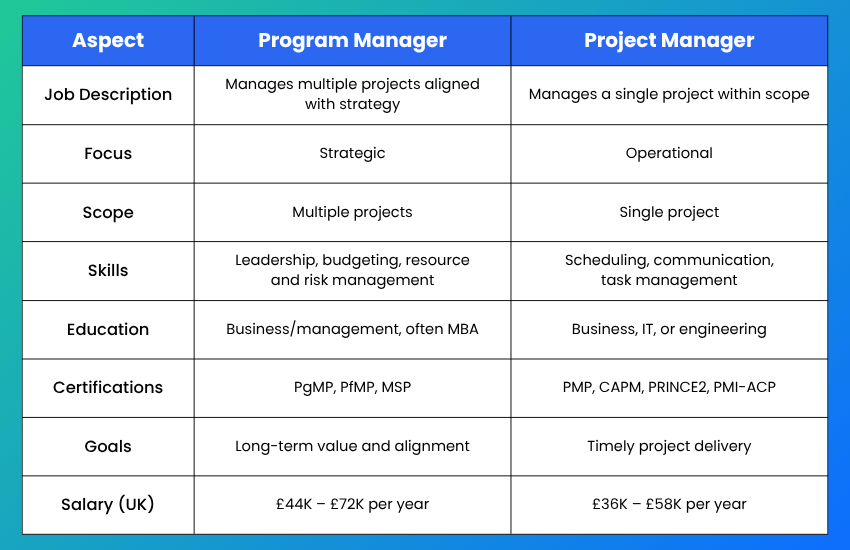
Understanding the differences between Program Manager vs Project Manager is essential for organisations aiming to balance strategy and execution. While both roles contribute to successful outcomes, they differ in scope, focus, and responsibilities. Let’s look at them below:
1) Job Description
The job roles of Program Managers and Project Managers differ in terms of scope, focus, and responsibilities. Let's look at them below:
1) Program Manager Job Description
A Program Manager oversees multiple related projects, ensuring they align with organisational goals. They focus on long-term strategy, manage dependencies, and coordinate teams to deliver overall program value.
2) Project Manager Job Description
A Project Manager plans and executes a single project within time, cost, and scope. They manage daily tasks, coordinate teams, and ensure deliverables are completed efficiently and on schedule.
2) Skills
Both Program Managers and Project Managers require strong skill sets, but their focus areas differ based on the scope and nature of their roles. Let's look at them below:
1) Program Manager Skills
Program Managers need skills that help them manage multiple projects at a strategic level and ensure alignment with organisational goals. It includes:
a) Communication Skills: Ensure clear coordination across stakeholders and teams
b) Leadership Skills: Guide multiple teams and managers towards shared goals
c) Project Budgeting: Manage budgets across several projects effectively
d) Resource Management: Allocate and optimise resources across program
e) Risk Management: Spot and manage risks at the program level
2) Project Manager Skills
Project Managers require skills that focus on planning, execution, and successful delivery of individual projects. It includes:
a) Project Scheduling: Create timelines and ensure tasks are completed on time
b) Communication Skills: Maintain clear communication with teams and stakeholders
c) Negotiation Skills: Align stakeholder expectations and project goals effectively
d) Task Management: Organise tasks, manage workload, and track project progress
Build strong foundations in Project Management with CAPM® Certification – Sign up now!
3) Education
Education plays an important role in preparing both Program Managers and Project Managers for their responsibilities, though the focus of learning may vary. Let's look at them below:
1) Program Manager Education
Program Managers require education that supports strategic thinking, leadership, and managing multiple projects at a broader level. Such as:
a) Degree in business, management, or a related field
b) Advanced education like a Master of Business Administration (MBA), is often beneficial
c) Focus on strategic planning and organisational leadership
2) Project Manager Education
Project Managers require education that builds strong foundations in planning, execution, and team management. Such as:
a) Degree in business, IT, engineering, or a related field
b) Focus on project execution and team coordination
c) Develops essential communication and organisational skills
4) Certifications
Certifications help both Program Managers and Project Managers validate their expertise and enhance their career opportunities, though the focus of certifications differs based on their roles. Let’s look at them below:
1) Program Manager Certifications
Program Managers pursue certifications that focus on managing multiple projects, strategic alignment, and program-level governance. Some key certifications include:
a) Program Management Professional (PgMP)
b) Portfolio Management Professional (PfMP)
c) Managing Successful Programs (MSP)
2) Project Manager Certifications
Project Managers go for certifications that strengthen their skills in planning, execution, and delivering individual projects successfully. Some key certifications include:
a) Project Management Professional (PMP)
b) Certified Associate in Project Management (CAPM)
c) PRINCE2 Foundation and Practitioner
d) PMI Agile Certified Practitioner (PMI-ACP)
Unlock Agile excellence in every sprint with PMI-ACP® Certification – Sign up today!
5) Goals
The goals of Program Managers and Project Managers differ based on their level of responsibility and focus within an organisation. Let’s look at them below:
1) Program Manager Goals
Program Managers focus on aligning multiple projects with organisational strategy and ensuring long-term value delivery. Some key goals are:
a) Align program objectives with organisational mission and strategy
b) Ensure projects collectively deliver value to the business and stakeholders
c) Focus on long-term outcomes and overall program success
d) Optimise performance across multiple projects
e) Ensure each project contributes to the wider organisational goals
2) Project Manager Goals
Project Managers focus on delivering individual projects efficiently by managing tasks, timelines, and resources. Some key goals are:
a) Achieve specific project objectives within the defined scope
b) Manage daily activities and team performance
c) Track milestones and ensure timely delivery of tasks
d) Focus on meeting deadlines and delivering project outputs
e) Ensure efficient use of resources to deliver value to customers
6) Salary
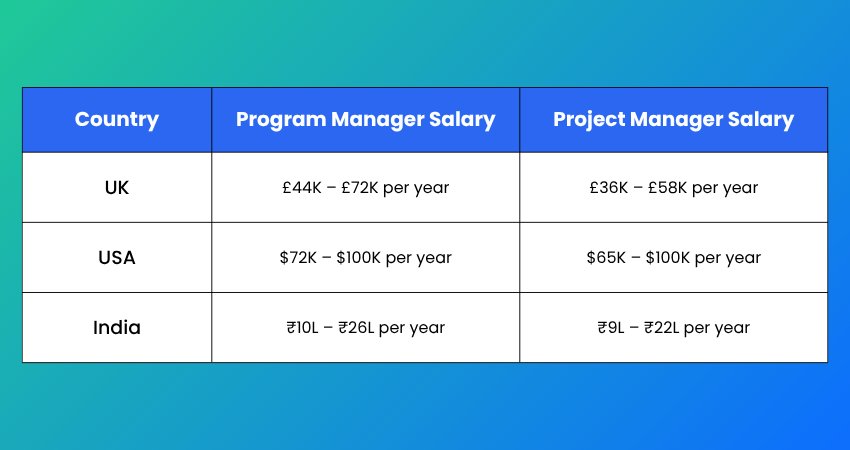
Salaries for Program Managers and Project Managers vary based on experience, location, and industry. Let’s look at the average salary ranges across the UK, USA, and India to understand the earning potential for each role:
1) Program Manager Average Salary
Program Managers earn higher salaries due to their strategic responsibilities and oversight of multiple projects. As per Glassdoor, in the UK, they typically earn between £44K and £72K annually. In the USA, salaries range from $72K to $100K per year, while in India, salaries range from ₹10L to ₹26L per year.
2) Project Manager Average Salary
Project Managers earn competitive salaries based on their role in delivering individual projects. As per Glassdoor, in the UK, salaries range from £36K to £58K per year. In India, salaries range from ₹9L to ₹22L per year, while in the USA, they earn between $65K and $100K annually.
Conclusion
Understanding the difference between Program Manager vs Project Manager is key to improving how organisations plan and deliver work. While Program Managers focus on strategy and long-term value, Project Managers ensure successful execution at the ground level. Recognising these roles helps businesses align goals, improve efficiency, and achieve better business outcomes.
Lead complex projects with proven skills by joining the PMP® Training today!
Search
- PRINCE2 vs APM: A Complete Guide to their Differences
- 10+ Project Management Tools to Boost Productivity in 2026
- What is Scrum? Agile Framework Explained
- What is Project Management? Phases, Approaches, and Benefits
- What is Agile Project Management? A Comprehensive Guide
- What are Project Management Skills: Top 25+ Skills You Must Know
- AI in Project Management: Benefits, Challenges, and Best Practices
- What is the Critical Path Method in Project Management? Explained
- What is Project Management Triangle? Key 3 Constraints Explained
- What are the Principles of Management? A Complete Overview
- ITIL Framework: Definition, Benefits and Implementation Explained
- What is Workflow Management? A Comprehensive Guide
- What is a Project Management Plan? Key Components and Benefits
- Why is Project Management Important? Top 12 Reasons & Tips
- Top 15 Project Management Methodologies You Should Know in 2026
- 15 Project Management Techniques Every Manager Should Use
- Project Timeline Explained: Simple Steps to Create Effective Plans
- How to Become a Project Manager: Skills, Steps, and Career Path
- Project Charter Explained: Components & How to Write It Effectively
- The 5 Project Management Phases Every Professional Should Know
- What is Risk Mitigation: Types, Steps, and Best Practices
No match found
Latest Blog
What is Risk Mitigation: Types, Steps, and Best Practices
June 27, 2026
The 5 Project Management Phases Every Professional Should Know
June 23, 2026
Program Manager vs Project Manager: A Complete Comparison Guide
June 23, 2026
Project Charter Explained: Components & How to Write It Effectively
June 23, 2026
FAQ
Yes, Program Managers are generally considered more senior than Project Managers. While Project Managers focus on executing individual projects within set timelines and budgets, Program Managers work at a strategic level, overseeing multiple projects.
Yes, a Project Manager can become a Program Manager as part of career growth. With experience, strategic thinking, and leadership skills, they can move from managing individual projects to overseeing multiple projects.
Program Managers typically earn higher salaries than Project Managers, as they manage multiple projects, handle broader strategic responsibilities, and oversee greater organisational complexity. However, actual compensation varies depending on experience, industry, location, and organisational structure.
.svg)