.svg)


What is Risk Mitigation: Types, Steps, and Best Practices
Risk Mitigation involves identifying potential risks and taking proactive steps to reduce their likelihood or impact on a project, business, or operation. It helps organisations minimise disruptions, protect resources, and maintain stability. It also supports better decision-making, strengthens resilience, and reduces uncertainties.
Maria Thompson
Imagine launching a major project only to face an unexpected cyberattack, supply chain disruption, or budget overrun that threatens to derail your plans. Risks are an unavoidable part of business, and while they cannot always be prevented, they can be managed effectively. This is where Risk Mitigation becomes essential, helping organisations identify potential threats and minimise their impact on business objectives.
Whether you're managing a project, running a business, or making strategic decisions, understanding Risk Mitigation can help you navigate uncertainty with greater confidence. In this blog, you'll learn why it matters, the common types of risks that organisations face, key mitigation strategies, implementation steps, and best practices for building resilience. Let's dive in!
What is Risk Mitigation?
Risk Mitigation is the process of identifying, assessing, and managing potential risks that could negatively affect an organisation's objectives, operations, or projects. As a key step in the Risk Management process, it involves implementing strategies and controls to reduce the likelihood of risks occurring or lessen their impact if they occur.
Rather than eliminating all risks, Risk Mitigation focuses on managing them effectively to reduce potential disruptions and losses. By proactively addressing risks, organisations can improve decision-making, maintain business continuity, and strengthen the organisation's ability to achieve its goals.
Why is Risk Mitigation Important?
Risk Mitigation helps organisations prepare for potential challenges and reduce their impact. Let’s check why it is important for your projects and business:
1) Financial Protection:
Risk Mitigation helps reduce financial losses by preventing minor issues from escalating into costly problems. By implementing preventive measures and contingency plans, organisations can avoid unexpected expenses, minimise operational downtime, and reduce the costs associated with recovery efforts. This helps maintain financial stability and protects valuable assets.
2) Business Continuity:
By preparing for potential disruptions, organisations can maintain critical operations and recover more quickly from unexpected events. Risk Mitigation ensures that backup plans, alternative resources, and response procedures are in place to minimise interruptions. As a result, businesses can continue serving customers, meeting commitments, and maintaining productivity even during challenging circumstances.
3) Regulatory Compliance:
Effective Risk Mitigation helps organisations comply with legal, regulatory, and industry requirements, reducing the risk of penalties, fines, and legal disputes. By regularly assessing risks and implementing appropriate controls, businesses can ensure that their processes align with applicable standards and regulations. This not only protects the organisation from compliance-related issues but also demonstrates accountability and good governance.
4) Reputation and Trust:
Managing risks proactively protects an organisation's reputation and strengthens trust among customers, employees, investors, and other stakeholders. A well-managed approach to risk reduces the possibility of incidents that could damage public perception or stakeholder confidence. Consistently addressing potential threats also helps organisations build long-term relationships and maintain a positive reputation.
5) Better Decision-making:
Understanding potential risks provides leaders with greater visibility into vulnerabilities, enabling more informed and strategic decision-making. Risk Mitigation supports the evaluation of possible outcomes, allowing organisations to balance opportunities with potential challenges. With a clearer understanding of risks, leaders can allocate resources, make confident decisions, and improve overall organisational performance.
Become a valuable contributor to successful large-scale Agile initiatives with the Certified SAFe® for Teams Training – Join now!
Types of Risks
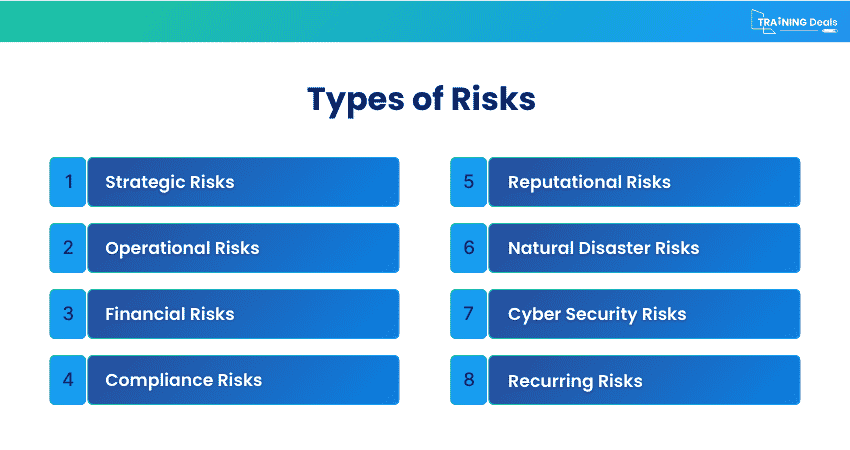
Organisations face various risks that can affect their operations, finances, reputation, and overall success. Understanding these risks enables organisations to develop effective mitigation strategies. Some of the most common types of risks include:
1) Strategic Risks:
These risks arise from decisions that affect an organisation's long-term direction, often due to market, technology, competition, or regulatory changes, evolving customer demands, and economic uncertainty.
2) Operational Risks:
Operational risks arise from failures in processes, systems, people, or daily operations. Common causes include human error, system failures, supply chain disruptions, process inefficiencies, and equipment breakdowns.
3) Financial Risks:
Financial risks involve the possibility of financial loss caused by factors such as market fluctuations, credit issues, liquidity shortages, changing interest rates, investment losses, and cash flow challenges.
4) Compliance Risks:
Compliance risks occur when organisations fail to meet legal, regulatory, or industry requirements. This can lead to penalties, legal action, financial losses, and reputational damage.
5) Reputational Risks:
These risks relate to events that negatively impact public perception of an organisation. Product failures, ethical concerns, poor customer service, negative publicity, legal disputes, and data breaches are common causes.
6) Natural Disaster Risks:
Natural disaster risks arise from events such as floods, earthquakes, storms, and wildfires. These events can disrupt operations, damage assets, cause financial losses, and affect business continuity and productivity.
7) Cyber Security Risks:
Cyber security risks arise from threats that compromise systems, networks, or data. Common examples include data breaches, ransomware attacks, phishing scams, malware infections, and unauthorised access.
8) Recurring Risks:
Recurring risks are risks that occur repeatedly over time, such as seasonal supply chain disruptions, cyber security incidents, or ongoing operational issues. They require continuous monitoring, assessment, and management to minimise their impact.
Advance your Agile expertise and deliver projects with confidence through the Agile Project Management Practitioner (AgilePM® v3) Training – Sign up now!
Steps for Successful Risk Mitigation
Successful Risk Mitigation requires a structured approach to identifying, assessing, and managing potential threats. The following steps provide a practical framework for managing risks and minimising their impact:
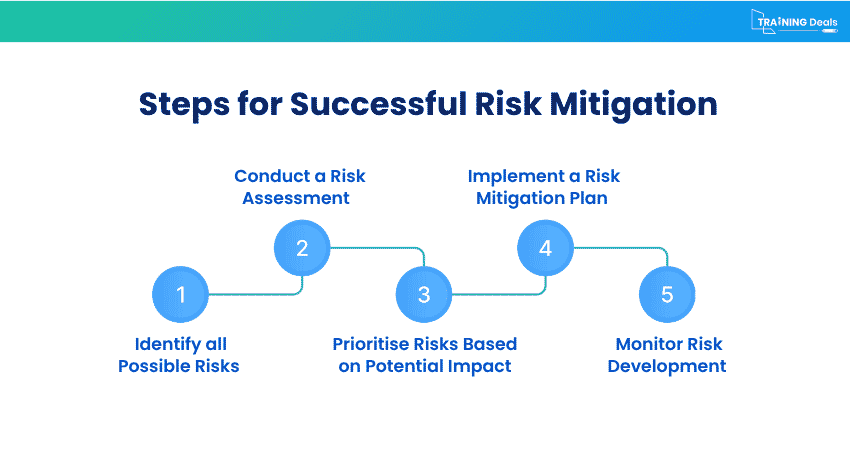
Step 1. Identify all Possible Risks
The first step is to find potential risks that could affect the organisation. This involves reviewing business operations, strategic goals, financial activities, regulatory requirements, and external factors that may create uncertainty. Gathering input from stakeholders across different departments can help ensure a comprehensive understanding of potential risks.
Step 2. Conduct a Risk Assessment
Once risks are identified, their potential impact and likelihood should be evaluated. Organisations can use tools such as risk matrices, scenario analysis, and expert evaluations to determine which risks require immediate attention. This helps organisations prioritise their mitigation efforts effectively.
Step 3. Prioritise Risks Based on Potential Impact
Not all risks carry the same level of significance. After assessment, risks should be prioritised according to their probability and potential consequences. High-impact and high-likelihood risks should be addressed first, helping organisations allocate resources and focus on the most critical risks.
Step 4. Implement a Risk Mitigation Plan
This step involves developing and implementing a Risk Mitigation plan that defines actions to manage prioritised risks. This may include strategies such as risk avoidance, reduction, transfer, or acceptance. Clear responsibilities, timelines, and resources should be assigned to ensure the plan is executed effectively and communicated to relevant stakeholders.
Step 5. Monitor Risk Development
Effective Risk Mitigation is an ongoing effort that requires continuous monitoring. Organisations should regularly review risks, track key indicators, and monitor changes in the risk environment. Monitoring helps detect emerging threats, evaluate the effectiveness of existing controls, and ensure that mitigation efforts remain relevant.
Risk Mitigation Strategies
Risk Mitigation strategies help organisations reduce the occurrence or impact of threats and vulnerabilities. The following are the most common strategies used to manage risks:
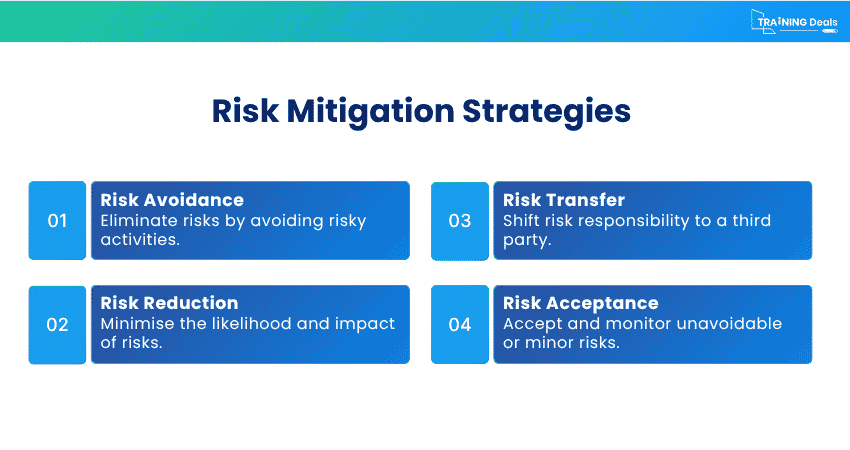
1) Risk Avoidance
Risk avoidance involves eliminating a risk entirely by avoiding the activity or situation that creates it. This strategy is often used when the potential consequences outweigh the expected benefits. For example, an organisation may choose not to enter a high-risk market or discontinue a project with significant uncertainties.
2) Risk Reduction
Risk reduction focuses on decreasing the likelihood of a risk occurring or minimising its impact if it does occur. This is one of the most widely used strategies and often involves implementing controls, procedures, and safeguards. Examples include cyber security measures, employee training, quality assurance processes, and backup systems.
3) Risk Transfer
Risk transfer involves shifting the financial or operational impact of a risk to a third party. While the risk itself remains, the responsibility for managing its consequences is shared or transferred. Common examples include purchasing insurance, outsourcing specific activities, or establishing contractual agreements with suppliers and service providers.
4) Risk Acceptance
Risk acceptance occurs when an organisation decides to acknowledge and tolerate a risk because its potential impact is low or the cost of mitigation exceeds the potential loss. In such cases, organisations continue to monitor the risk and prepare appropriate response plans if it materialises.
Gain professional Agile skills to deliver successful projects through the Certified Professional in Agile Project Management (CPAPM) Training – Register now!
Risk Mitigation Best Practices
Effective Risk Mitigation requires more than identifying risks. Organisations should follow best practices to manage risks consistently and ensure mitigation efforts remain effective. Key practices include:
1) Keep Stakeholders Informed
Effective communication is a key part of Risk Mitigation. Organisations should keep stakeholders informed about potential risks, mitigation measures, and any changes in the risk landscape. Regular communication promotes transparency, improves collaboration, and ensures everyone understands their role in managing risks.
2) Establish a Strong Risk Culture
A strong risk culture encourages employees at all levels to recognise, report, and address risks proactively. This culture should be supported by leadership and embedded throughout the organisation, helping to ensure that Risk Management becomes a core part of everyday decision-making and operations.
3) Implement Risk Tools
Risk Management tools help organisations identify, assess, monitor, and report risks more effectively. Solutions such as risk assessment frameworks, dashboards, and monitoring systems provide greater visibility into risk levels and support informed decision-making across the organisation.
4) Conduct Regular Risk Assessments
Risks can evolve as business environments, technologies, and regulations change. Conducting regular risk assessments helps organisations maintain an up-to-date understanding of potential threats, evaluate the effectiveness of available controls, and make informed decisions to strengthen Risk Mitigation efforts.
Conclusion
Risk Mitigation plays a vital role in helping organisations prepare for uncertainty and minimise the impact of potential threats. By identifying risks early, implementing appropriate strategies, and following proven best practices, businesses can strengthen resilience and maintain operational stability. This proactive approach enables organisations to protect valuable resources, navigate challenges with confidence, and support long-term success.
Develop Agile expertise and lead high-performing teams confidently with the Agile Training – Join now!
Search
- PRINCE2 vs APM: A Complete Guide to their Differences
- 10+ Project Management Tools to Boost Productivity in 2026
- What is Scrum? Agile Framework Explained
- What is Project Management? Phases, Approaches, and Benefits
- What is Agile Project Management? A Comprehensive Guide
- What are Project Management Skills: Top 25+ Skills You Must Know
- AI in Project Management: Benefits, Challenges, and Best Practices
- What is the Critical Path Method in Project Management? Explained
- What is Project Management Triangle? Key 3 Constraints Explained
- What are the Principles of Management? A Complete Overview
- ITIL Framework: Definition, Benefits and Implementation Explained
- What is Workflow Management? A Comprehensive Guide
- What is a Project Management Plan? Key Components and Benefits
- Why is Project Management Important? Top 12 Reasons & Tips
- Top 15 Project Management Methodologies You Should Know in 2026
- 15 Project Management Techniques Every Manager Should Use
- Project Timeline Explained: Simple Steps to Create Effective Plans
- How to Become a Project Manager: Skills, Steps, and Career Path
- Project Charter Explained: Components & How to Write It Effectively
- Program Manager vs Project Manager: A Complete Comparison Guide
- The 5 Project Management Phases Every Professional Should Know
No match found
Latest Blog
What is Risk Mitigation: Types, Steps, and Best Practices
June 27, 2026
The 5 Project Management Phases Every Professional Should Know
June 23, 2026
Program Manager vs Project Manager: A Complete Comparison Guide
June 23, 2026
Project Charter Explained: Components & How to Write It Effectively
June 23, 2026
FAQ
A common example of Risk Mitigation is implementing cyber security safeguards, including firewalls, encryption, and security training, to reduce cyber risks. These actions help protect sensitive data, minimise potential losses, and support business continuity during security incidents.
Organisations can evaluate Risk Mitigation by monitoring key risk indicators, reviewing incidents, and conducting regular risk assessments. Audits, performance reviews, and stakeholder feedback also help determine whether mitigation measures are effectively reducing the likelihood or impact of risks.
Risk Mitigation is a shared responsibility across the organisation. Leadership establishes the framework and accountability, Risk Managers identify and assess risks, and Risk Owners implement and monitor mitigation measures to ensure risks are managed effectively.
.svg)