.svg)


What is a Project Management Plan? Key Components and Benefits
A Project Management Plan is a formal roadmap that defines scope, budget, schedule, roles, and processes to guide successful project execution and control. It aligns stakeholders, clarifies responsibilities across the lifecycle, and supports structured decision-making. It helps manage risks, control costs, and ensure timely delivery.
Gary Moore
Think about assembling flat-pack furniture without reading the instructions. You might manage the first few steps, but soon parts seem missing, screws do not fit, and frustration builds. Projects work the same way. Whether you are launching a startup idea, planning a company event, or leading a team assignment, jumping in without a clear plan often leads to delays, confusion, and wasted effort. To avoid these challenges, having a structured roadmap is essential.
This is exactly why understanding What is a Project Management Plan matters. In this blog, you will explore What is a Project Management Plan, why it is important, its key components and how to create one effectively. By the end, you’ll see how a well-structured plan can guide your team, reduce risks, and drive successful project outcomes.
What is a Project Management Plan?
A Project Management Plan is a formal and comprehensive document that integrates all key planning elements required to manage a project from initiation to closure. It acts as a roadmap for the project team and stakeholders, outlining the project’s scope, objectives, timeline, budget, resources, risks, and communication methods.
In simple terms, a Project Management Plan defines who will do what, when it will be done, and how success will be measured. By bringing all key elements into one structured plan, it improves coordination, controls costs, manages risks, and increases the likelihood of successful delivery.

Why Do You Need a Project Management Plan?
A Project Management Plan is important because it provides clear direction, governance, and control throughout the project lifecycle. It outlines what needs to be done, when it should be completed, how much it will cost, and what quality standards must be met. By providing this roadmap, it keeps the team aligned and focused on shared goals.
Project Management Plans also play a key role in reducing uncertainty. A well-prepared plan helps identify risks early, improves communication among stakeholders, prevents uncontrolled changes in scope, and ensures resources such as time, money, and people are used efficiently. This establishes the foundation for predictable and measurable project performance.
Key Components of a Project Plan
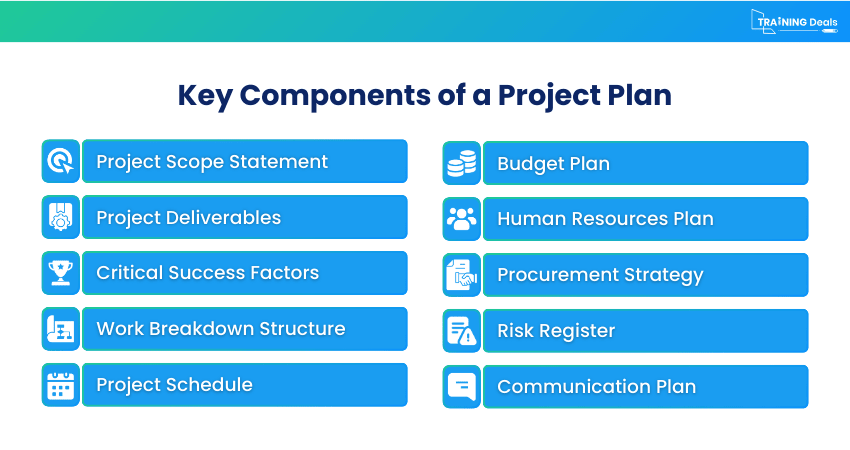
A well-developed Project Management Plan combines the key elements needed to execute, monitor, and control a project effectively. Each component defines how the project will be structured and managed. Let’s explore these essential components in detail:
1) Project Scope Statement
The Project Scope Statement defines the project’s purpose, objectives, boundaries, assumptions, and constraints. It clearly states what is included and excluded from the project. A well-defined scope establishes alignment among stakeholders and prevents uncontrolled changes during execution.
2) Project Deliverables
Project Deliverables are the specific outputs the project must produce, such as products, services, reports, or systems. They define what will be handed over at completion. Clearly documented deliverables ensure expectations are measurable and aligned with stakeholder requirements.
3) Critical Success Factors
Critical Success Factors identify the essential conditions that determine project success. These may include meeting cost targets, maintaining quality standards, achieving performance benchmarks, or satisfying stakeholders. They provide measurable criteria that guide monitoring and performance evaluation throughout the project lifecycle.
4) Work Breakdown Structure
The Work Breakdown Structure breaks the project into smaller, manageable components or work packages. It organises tasks hierarchically, making planning, scheduling, cost estimation, and responsibility assignment more effective. A structured WBS improves clarity and supports better tracking and control.
5) Project Schedule
The Project Schedule outlines task sequences, dependencies, milestones, and timelines. It defines when activities start and finish, helping manage time effectively. Scheduling tools such as Gantt charts or network diagrams are often used to monitor progress and maintain delivery timelines.
6) Budget Plan
The Budget Plan estimates total project costs, including labour, materials, equipment, and external services. It establishes cost baselines and financial control measures. Effective budgeting ensures funds are allocated properly and prevents cost overruns during project execution.
7) Human Resources Plan
The Human Resources Plan defines the project team structure, roles, responsibilities, and required competencies. It outlines reporting relationships and staffing requirements. This ensures the right skills are available at the right time to complete project tasks efficiently and effectively.
8) Procurement Strategy
The Procurement Strategy explains how goods, services, or external resources will be acquired. It covers vendor selection methods, contract types, purchasing processes, and supplier management. A structured procurement approach ensures cost efficiency and alignment with organisational policies.
9) Risk Register
The Risk Register identifies potential project risks, evaluates their likelihood and impact, and documents mitigation or response strategies. It assigns risk ownership and monitors risk status. Proactive risk management reduces uncertainty and protects project objectives from disruption.
10) Communication Plan
The Communication Plan defines how information will be shared among stakeholders. It specifies communication channels, reporting frequency, meeting schedules, and responsibilities. Effective communication ensures transparency, stakeholder engagement, and alignment throughout the project lifecycle.
Gain practical Project Management knowledge and stand out to employers through the PMI Project Management Ready Training – Join now!
How to Create a Project Plan: Step-by-Step Guide?
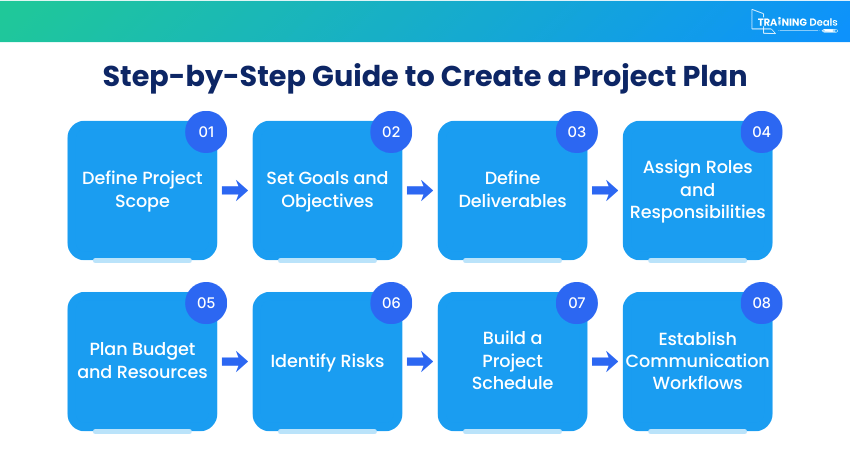
Creating a Project Management Plan requires structured thinking. Below is a step-by-step guide to help you build an effective plan:
Step 1: Define Project Scope
Create a clear scope statement outlining what the project will deliver and what it excludes. Define objectives, constraints, and assumptions. Use insights from previous projects to estimate timelines realistically and share the scope early with stakeholders to prevent misunderstandings and scope creep. A clearly defined scope lays the foundation for a more productive project environment.
Step 2: Set Goals and Objectives
Convert the scope into SMART goals that are specific, measurable, achievable, relevant, and time-bound. Within a structured Project Management Plan, clear objectives provide direction and measurable outcomes. Validated deadlines keep teams focused, aligned, and working in a disciplined, productive manner throughout the project lifecycle.
Step 3: Define Deliverables
Break objectives into tangible deliverables such as reports, prototypes, or completed features. Within a structured Project Management Plan, estimate time and resource requirements based on prior experience. Linking each deliverable to milestones improves visibility, strengthens accountability, and ensures consistent, productive progress tracking throughout the project lifecycle.
Step 4: Assign Roles and Responsibilities
Clarify ownership for every task to ensure accountability and transparency across the team. Within a well-structured Project Management Plan, clearly defined roles prevent duplication of effort and confusion. This creates an organised structure that improves coordination, strengthens collaboration, and promotes a more productive working environment.
Step 5: Plan Budget and Resources
Estimate costs for personnel, tools, materials, and external services using reliable forecasting methods. A strong Project Management Plan establishes a realistic cost baseline and tracks spending against projections. Proper budgeting ensures efficient resource allocation, prevents overruns, and supports financially sustainable project execution.
Step 6: Identify Risks
Develop a detailed risk register documenting potential threats, likelihood, impact, and mitigation strategies. An effective Project Management Plan incorporates proactive risk management to minimise disruptions. By assigning ownership and monitoring risks regularly, teams maintain stability and ensure a controlled workflow throughout the project lifecycle.
Step 7: Build a Project Schedule
Sequence activities logically, define dependencies, and establish measurable milestones. A comprehensive Project Management Plan includes a realistic schedule that guides task execution and resource coordination. Clear timelines prevent bottlenecks, improve accountability, and maintain consistent momentum across the entire project timeline.
Step 8: Establish Communication Workflows
Define how updates, feedback, and issues will be communicated among stakeholders. A structured Project Management Plan outlines reporting frequency, channels, and escalation procedures. Clear communication improves alignment, reduces misunderstandings, strengthens stakeholder engagement, and fosters a transparent, collaborative, and productive team culture.
Phases of the Project Planning Process
The Project Planning Process consists of five structured phases that guide a project from concept to completion. These phases establish clear checkpoints, maintain stakeholder alignment, and ensure controlled progress. Each phase has defined objectives, inputs, and outputs. Let’s explore them one by one:
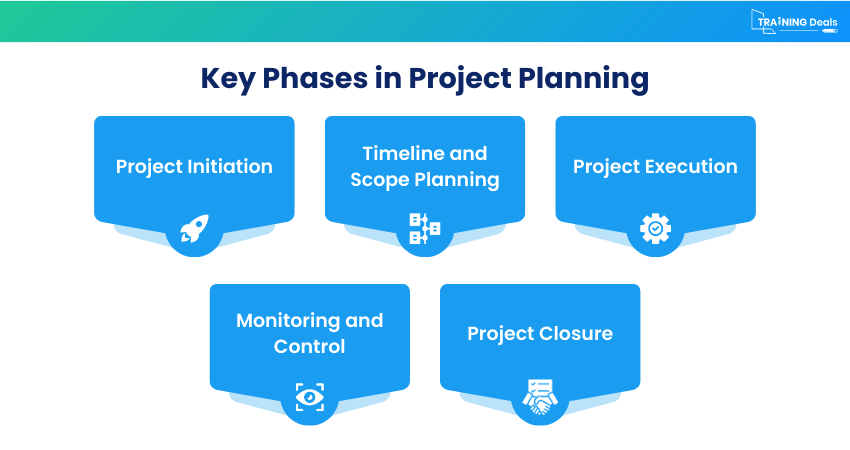
1) Project Initiation
The Initiation phase establishes the project’s purpose, objectives, and overall feasibility. Its primary aim is to secure stakeholder approval and confirm business justification before allocating resources. A well-managed initiation phase sets a strong strategic foundation.
Required Input: Business case, stakeholder expectations, high-level concept.
Output: Approved project charter and formal authorisation to proceed.
2) Timeline and Scope Planning
This phase develops the detailed blueprint for execution. Teams define scope, deliverables, budget, schedule, risks, and communication strategies. Thorough planning reduces uncertainty, clarifies expectations, and aligns all stakeholders around a shared roadmap.
Required Input: Approved charter, stakeholder requirements, historical data.
Output: Comprehensive Project Plan including scope statement, WBS, schedule, budget, risk register, and communication framework.
3) Project Execution
Execution involves implementing the approved plan and producing the agreed deliverables. Resources are managed, tasks are completed, and progress is tracked. This phase directly influences quality, timelines, and overall performance.
Required Input: Finalised Project Plan, assigned team members, tools, and resources.
Output: Completed deliverables in line with planned objectives.
4) Monitoring and Control
This phase operates alongside execution to ensure alignment with scope, time, and cost baselines. Performance is measured, risks are reviewed, and corrective actions are applied when necessary to maintain control.
Required Input: Real-time progress data, financial tracking, performance metrics.
Output: Status reports, issue resolutions, risk updates, and implemented adjustments.
5) Project Closure
Closure formally concludes the project. Deliverables are validated, stakeholder acceptance is obtained, and lessons learned are documented. This phase ensures accountability, organisational learning, and proper resource release.
Required Input: Approved deliverables, stakeholder sign-off, team feedback.
Output: Formal closure documentation, released resources, and recorded lessons learned.
Advance your leadership journey with elite Program Management Professional (PgMP)® Certification – Register today!
Benefits of Having a Clear Project Management Plan
A clear Project Management Plan provides structure and direction, enabling efficient project delivery. By clearly defining goals, timelines, resources, responsibilities, and performance measures, it reduces uncertainty and improves overall project outcomes. Below are the key benefits:
1)Enhanced Clarity and Focus
A well-defined plan outlines scope, objectives, deliverables, and timelines. It ensures clarity, keeps the team focused, and prevents unnecessary changes that lead to scope creep.
2) Improved Resource Management
The plan ensures efficient allocation of people, budget, and materials. It prevents overuse or underutilisation of resources and helps identify shortages early, allowing adjustments before they affect project progress.
3) Better Risk Management
A structured plan includes risk identification, assessment, and mitigation strategies. Proactive risk planning reduces delays, cost overruns, and disruptions, ensuring smoother project execution.
4) Increased Stakeholder Satisfaction
Regular updates, transparency, and structured reporting build trust with stakeholders. When expectations are clear and progress is visible, stakeholders feel confident and satisfied with the project direction.
5) Effective Time Management
By breaking the project into manageable tasks with defined milestones, the plan helps maintain schedules. It allows early detection of delays and supports quick corrective actions to protect deadlines.
6) Better Communication and Collaboration
A communication framework ensures consistent information sharing. Clear channels and reporting reduce misunderstandings, improve coordination, and strengthen teamwork across departments.
7) Improved Decision-Making
The plan serves as a reference for evaluating changes and challenges. Decisions are aligned with defined goals, reducing uncertainty and enabling timely, informed responses.
8) Cost Control
With a defined budget and monitoring system, expenses are tracked against planned costs. This helps prevent financial waste and ensures the project remains within approved limits.
9) Increased Accountability
Clearly assigned roles and responsibilities promote ownership. Team members understand their tasks and deadlines, improving performance and accountability.
10) Easier Evaluation and Continuous Improvement
A clear framework makes it easier to assess project performance against objectives, timelines, and budgets. Lessons learned can then be documented to improve future Project Planning and execution.
Example of a Project Management Plan
To understand how a Project Management Plan works, consider a company developing a new e-commerce website.
Project Overview: Launch a fully functional e-commerce platform within six months to increase online sales by 30 per cent.
Scope: Includes website design, product catalogue setup, payment integration, and user testing. Excludes digital marketing and post-launch maintenance.
Deliverables:
a) Approved design mock-ups
b) Functional website with a payment system
c) Secure checkout
d) User documentation
Schedule: Phased timeline covering design, development, testing, and deployment with milestone reviews.
Budget: £120,000 allocated for development, tools, testing, and contingency.
Resources: Project Manager, Developers, Designer, Content Specialist, and QA Tester.
Risk Management: Address risks such as delays and integration issues using contingency time and backup vendors.
Communication Plan: Weekly team meetings and bi-weekly stakeholder updates.
This example shows how a Project Management Plan integrates scope, time, cost, resources, and risks into a structured framework for successful delivery.
Conclusion
Understanding What is a Project Management Plan is the first step toward delivering projects with confidence and control. A well-structured plan turns ideas into organised action, aligns teams, reduces risks, and drives measurable results. Master the planning process, and you significantly increase your chances of project success.
Accelerate your Project Management career with industry-recognised PMP® Training – Join today!
Search
- PRINCE2 vs APM: A Complete Guide to their Differences
- 10+ Project Management Tools to Boost Productivity in 2026
- What is Scrum? Agile Framework Explained
- What is Project Management? Phases, Approaches, and Benefits
- What is Agile Project Management? A Comprehensive Guide
- What are Project Management Skills: Top 25+ Skills You Must Know
- AI in Project Management: Benefits, Challenges, and Best Practices
- What is the Critical Path Method in Project Management? Explained
- What is Project Management Triangle? Key 3 Constraints Explained
- What are the Principles of Management? A Complete Overview
- ITIL Framework: Definition, Benefits and Implementation Explained
- What is Workflow Management? A Comprehensive Guide
- Why is Project Management Important? Top 12 Reasons & Tips
- Top 15 Project Management Methodologies You Should Know in 2026
- 15 Project Management Techniques Every Manager Should Use
- Project Timeline Explained: Simple Steps to Create Effective Plans
- How to Become a Project Manager: Skills, Steps, and Career Path
- Project Charter Explained: Components & How to Write It Effectively
- Program Manager vs Project Manager: A Complete Comparison Guide
- The 5 Project Management Phases Every Professional Should Know
- What is Risk Mitigation: Types, Steps, and Best Practices
No match found
Latest Blog
What is Risk Mitigation: Types, Steps, and Best Practices
June 27, 2026
The 5 Project Management Phases Every Professional Should Know
June 23, 2026
Program Manager vs Project Manager: A Complete Comparison Guide
June 23, 2026
Project Charter Explained: Components & How to Write It Effectively
June 23, 2026
FAQ
No FAQs available for this blog.
.svg)