.svg)


Finance vs Accounting: Understanding the Key Differences
Finance and Accounting both manage business finances. Accounting records and reports transactions, while Finance plans budgets, investments, and future growth. Understanding how they differ and work together helps organisations improve financial control, make informed decisions, and use resources effectively to achieve long-term success.


Maria Thompson
Understanding how businesses manage money can be confusing, especially when terms like Finance vs Accounting are used interchangeably. Although they are closely linked, both play a unique role in managing financial activities. Knowing the differences helps you see how organisations track results and plan effectively.
For professionals and organisations, understanding Finance vs Accounting brings clarity to how financial decisions are made. As per Grand View Research Accounting services market is expected to reach approximately £950 billion by 2033, its importance in modern organisations continues to grow. In this blog, you will learn about Finance vs Accounting, their types and differences. Let's begin!
What is Finance?
Finance is the management of money and investments for individuals, businesses, and governments. It focuses on how funds are raised, used, and managed to meet financial needs and support growth.
Finance professionals work in areas such as investment banking, wealth management, and financial planning. Their role is to ensure there is enough funding available and that it is used in the best possible way to create business value.

Types of Finance
Finance is divided into different types based on who manages the money and how it is used. Understanding these types helps you see how financial systems work in different areas. Let's look at them below:
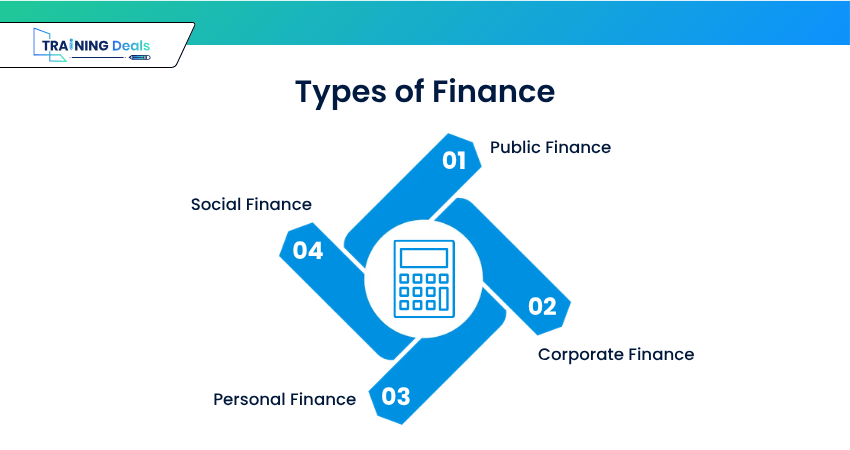
1) Public Finance
Public Finance refers to how governments manage income and spending. It involves taxation, budgeting, and allocating funds to support public services like healthcare, education, and infrastructure while maintaining economic stability.
2) Corporate Finance
Corporate Finance deals with how businesses raise and manage funds to support business growth. It involves identifying funding sources, such as loans or equity, investment and capital budgeting decisions, and managing risks while distributing profits effectively.
3) Personal Finance
Personal Finance focuses on managing money for individuals or families. It includes budgeting, saving, investing, and insurance to meet financial goals. Also, it helps in planning for future needs such as retirement, education, or major life expenses while avoiding unnecessary debt.
4) Social Finance
Social Finance means to invest in projects that create a positive social or environmental impact. It includes funding social enterprises, charities, and small businesses to improve communities and support long-term social development.
What is Accounting?
Accounting is the process of recording, maintaining, and reporting a company’s financial transactions. It ensures that all financial data is organised and accurately stored in records such as the general ledger.
Accounting professionals are responsible for checking that account balances are correct and that financial statements are reliable. This helps businesses track performance, meet legal requirements, and make informed financial decisions.
Turn spreadsheets into smart financial insights and upgrade your Accounting skills with the Excel for Accounting Course – Sign up today!
Types of Accounting
Accounting is divided into different types. Each type serves a specific purpose within a business. Understanding them helps you see how Accounting functions in different areas of an organisation. Let's look at them below:
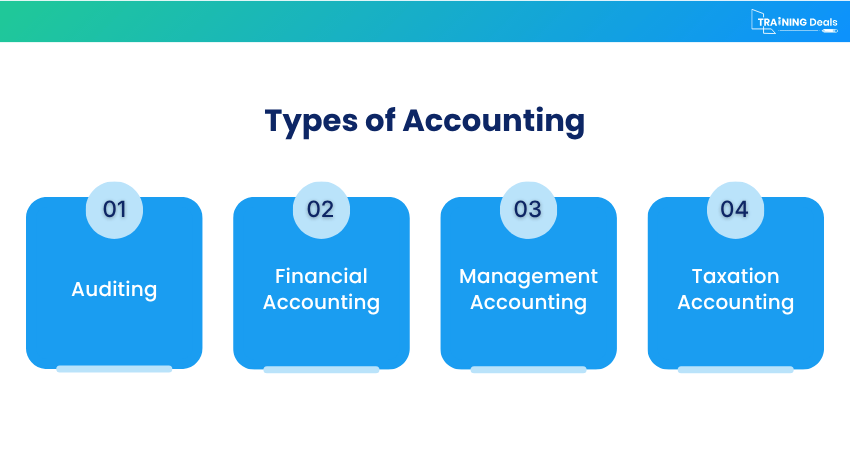
1) Auditing
Auditing is the process of examining financial records to ensure accuracy and compliance with set regulations. It helps to identify errors and build trust among stakeholders. Audits can be internal, external, or conducted by government authorities.
2) Financial Accounting
Financial Accounting involves recording, summarising, and reporting a company’s financial transactions over a specific period. It produces financial statements that show the company’s performance and position to external stakeholders, such as investors and regulators.
3) Management Accounting
Management Accounting focuses on preparing financial information for internal use. It helps managers plan, control costs, analyse performance, and make informed business decisions through budgeting, forecasting, and financial analysis.
4) Taxation Accounting
Taxation Accounting deals with preparing tax returns and managing tax payments. It ensures compliance with tax laws and involves calculating taxable income based on applicable rules, deductions, and credits.
Transform Accounting with AI-driven insights and future-proof your Accounting career with Certified Artificial Intelligence (AI) for Accountants Training – Sign up today!
The Differences Between Finance and Accounting
Finance and Accounting are closely connected, but they differ in how they view, manage, and use financial information. Understanding these differences helps clarify Finance vs Accounting. Let’s look at the key differences in the table below:
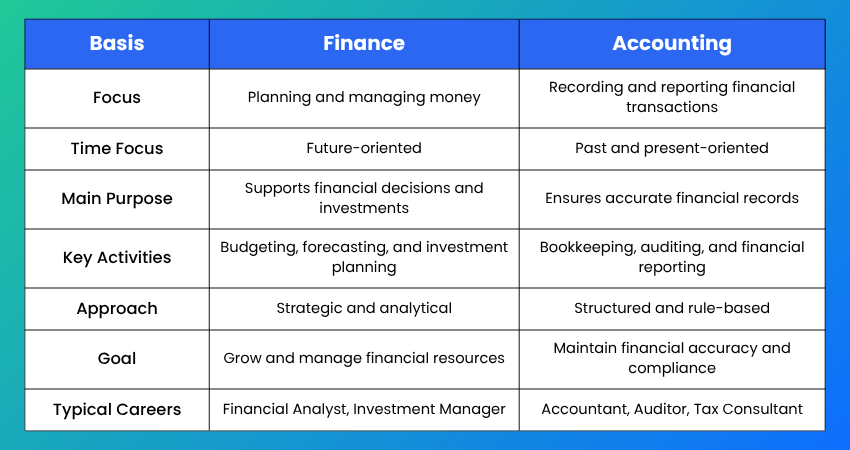
1) The Scope and Focus
Accounting focuses on past and present financial data. It records transactions and provides a clear picture of a company’s financial position. Also, it relies on structured records to show what a business owns and owes.
In contrast, Finance is forward-looking. It focuses on how money can be used to generate future value. It looks at cash flow, investments, and financial planning to support growth and long-term business success.
2) Measuring Financial Performance
Accounting measures performance using recorded transactions. It follows the accrual method, where income and expenses are recorded when they are agreed. This helps present a stable and consistent view of performance over time.
In contrast, Finance measures performance based on actual cash flow. It focuses on how much cash a business generates and how effectively it is used. This approach helps in making investment decisions and assessing real financial strength.
3) Assessing Value
Accounting takes a conservative approach when estimating value. It avoids overestimating assets and ensures liabilities are properly recognised. This helps to maintain accuracy and reduce financial risk.
In contrast, Finance uses valuation methods to estimate the future worth of a business or an investment. It analyses expected cash flows and risks to assess the current value, helping organisations make informed investment decisions.
4) Education and Career Paths
Accounting education focuses on financial reporting, auditing, and tax regulations. It teaches how to record transactions accurately, maintain financial records, and ensure compliance with standards. This knowledge supports careers such as Tax Accountant, Auditor, and Cost Accountant, where professionals ensure financial accuracy and reliability.
In contrast, Finance education focuses on areas such as investments, risk management, financial markets, and business Finance. It prepares individuals to analyse data, manage capital, and make strategic decisions for future growth. This background leads to careers such as Investment Banker, Risk Manager, and Portfolio Analyst.
Conclusion
Understanding Finance vs Accounting gives you a clear view of how businesses manage money with both accuracy and strategy. While Accounting ensures reliable records and compliance, Finance focuses on planning, investments, and future growth. Together, they help organisations make informed decisions, manage risks effectively, and build a strong financial foundation.
Build a strong foundation in modern Accounting and help businesses drive real value with Accounting Courses – Sign up now!
Search
Latest Blog
What is Risk Mitigation: Types, Steps, and Best Practices
June 27, 2026
The 5 Project Management Phases Every Professional Should Know
June 23, 2026
Program Manager vs Project Manager: A Complete Comparison Guide
June 23, 2026
Project Charter Explained: Components & How to Write It Effectively
June 23, 2026
FAQ
The level of difficulty between Finance and Accounting depends on your strengths. Accounting is often seen as more difficult due to its technical and rule-based nature, while Finance is more theoretical and focused on analysis and decision-making.
The No.1 rule in Accounting is “Debit what comes in, Credit what goes out.” It applies to real accounts that track assets like cash or equipment. When an asset is received, it is debited, and when it leaves or is sold, it is credited.
The level of pay in both Finance and Accounting varies based on role, experience, industry, and skills. Finance roles include performance-based rewards, while Accounting offers steady growth and stability. In both fields, experienced and specialised professionals can earn handsome and competitive salaries.
.svg)